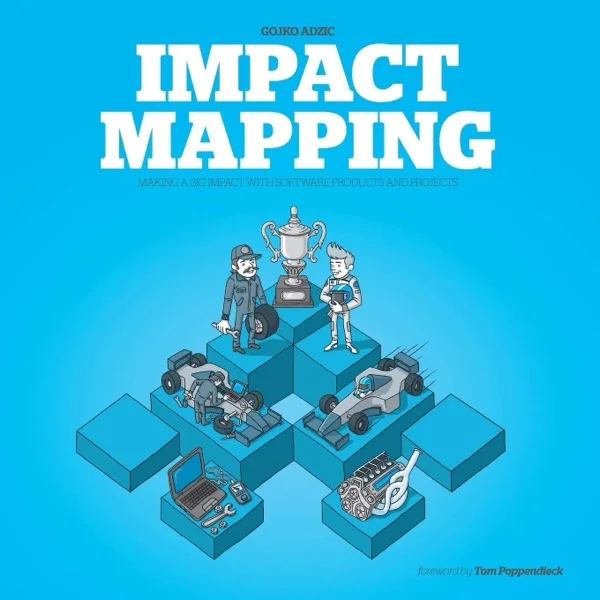
"Impact Mapping", by Gojko Adzic, lays out a visual method for connecting business goals with software delivery decisions. Through four questions —why?, who?, how? and what?— it builds a shared understanding between the people who set priorities and the people who build the solutions. It is a particularly useful read for technology leaders, product owners, founders and teams that need to decide what to build and explain why it is worth building. The method helps to revisit priorities, make assumptions explicit and adapt plans as new information arrives. The author's page for the book.
BOOK SUMMARY
An impact map connects four levels: the goal, the actors, the behaviour changes you expect, and the deliverables that might enable them.
Question
Element of the map
What it defines
Why? What are we doing this for?
Goal
The business outcome we are trying to reach.
Who? Who can influence that outcome?
Actors
The people or groups who can help the goal or get in its way.
How? How should their behaviour change?
Impacts
The changes we need to encourage to move closer to the outcome.
What? What can we do to enable those changes?
Deliverables
The features, actions or interventions that might produce those impacts.
The third level deserves particular attention: impact here means a change in the behaviour of the actors. A customer who buys more often, for instance, or a user who completes a task without help.
Deliverables can be software, and they can also be organisational actions. A feature is one possible intervention inside a chain of reasoning that has to be made explicit. How the four questions work.
ALIGNING THE TEAM AND MAKING ASSUMPTIONS VISIBLE
The map is built through a conversation between business and technology. Its value lies in discussing what we want to achieve, what we assume about the people involved, and why certain actions might work.
Every connection states a hypothesis: that a deliverable will enable a behaviour, and that the behaviour will contribute to the goal. Seeing those relationships drawn out surfaces disagreements that a list of requirements can hide.
PRIORITISING AND LEARNING WHILE YOU DELIVER
Adzic proposes revisiting the map as results come in. After a release, the team can observe whether the expected behaviour changed, and whether that change contributed to the goal.
That learning makes it possible to carry on, to change a solution, or to explore a different one. The map gives a shared reference for adjusting scope and for avoiding investment in features whose contribution to the business is unclear. Foundations and applications of the method.
AN EXAMPLE TO PUT IT INTO PRACTICE
Imagine an online shop trying to increase repeat purchases. The example shows the logic of the method:
Goal: increase repeat sales.
Actor: customers who have already bought once.
Expected impact: that they buy again more often.
Possible deliverable: a one-click repeat order.
You can also walk the reasoning backwards, from the feature: which behaviour do we expect to change, in whom, to achieve what outcome? The conversation might reveal that repeating an order is hard, and also that purchase frequency depends on other conditions. That opens the door to researching and comparing interventions before committing to development.
What I value most in Impact Mapping is how clearly it lets you walk back from a feature to the goal that should justify it. With a handful of questions, it turns a discussion about requirements into a conversation about the business.
I am especially interested in how it aligns a team. We can agree to build something and, at the same time, hold very different views on why it is useful. Making the actors, the behaviours and the expected outcomes explicit lets us examine those differences and decide better.
From the Scalabl® perspective, I find a fertile connection with our work on business hypotheses. A proposed solution carries assumptions about people and about the consequences of their actions. Stating them clearly is what allows us to research, experiment and learn.
I recommend this book to anyone who needs to connect strategy, product and technology in plain language. Its contribution is a structure for the conversation: one that helps you think before building, and revise decisions while you learn.
FREQUENTLY ASKED QUESTIONS
What is Impact Mapping?
It is a visual planning technique that relates business goals, actors, behaviour changes and deliverables. It exists so that delivery decisions carry a shared and explicit purpose.
What are the four questions of Impact Mapping?
Why?, Who?, How? and What?: what we are doing this for, who can influence the outcome, how their behaviour should change, and what we can do to enable that change. Guide to the method.
Do you need to know how to code to read it?
No. The book addresses both business participants and the professionals involved in delivering software. Its approach lets product owners, sponsors and technical teams talk about goals and priorities together. Who the book is for.
Reading is the beginning. Applying is the leap.
At Scalabl you don't stop at the summary: you take the best business ideas to your own venture. Our flagship Entrepreneurship & Innovation Course: 10 years running, graduates in 50+ countries, 12 modules at your own pace.