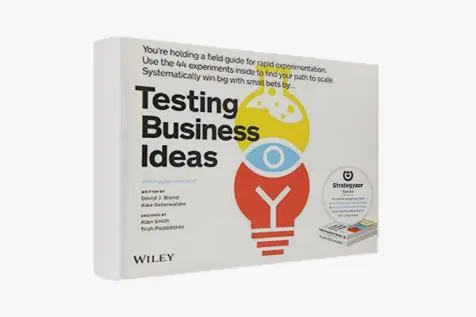
Testing Business Ideas by Alexander Osterwalder and David J. Bland is the definitive field guide for reducing risk in innovation. Through 44 practical experiments, the authors provide a systematic framework for validating assumptions before committing significant resources to developing new products, services, or business models.
“Most new ideas fail not because they are bad, but because they were never systematically tested before being executed.” — Alexander Osterwalder & David J. Bland
BOOK SUMMARY
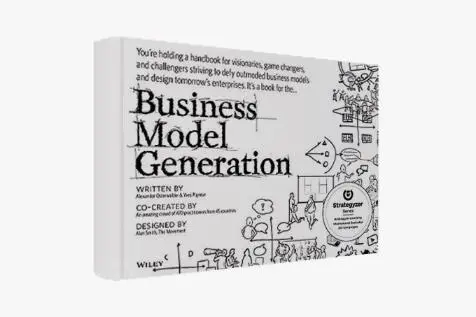
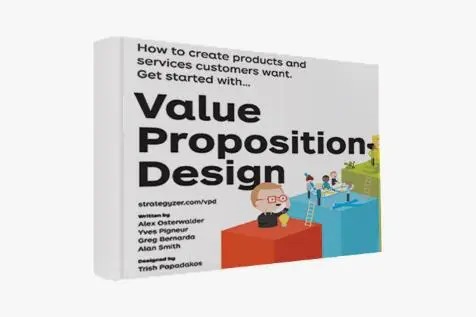
Testing Business Ideas completes the practical trilogy that Osterwalder began with Business Model Generation and continued with Value Proposition Design. If those books taught how to design business hypotheses, this one teaches how to validate them before going all in. The book presents 44 concrete experiments—from discovery interviews and landing pages to pretotyping and Wizard of Oz prototypes—organized by the level of evidence they produce. Each experiment includes step-by-step instructions, estimated time, cost, and the strength of evidence generated.
The book’s central framework revolves around the idea that all innovation begins with assumptions that must be identified, prioritized, and tested quickly and affordably. The authors introduce the concept of “test cards” and “learning cards” as tools to document hypotheses, design experiments, measure results, and make evidence-based decisions. The goal is to drastically reduce uncertainty before scaling, turning experimentation into a systematic discipline within the organization.
This book completes Osterwalder’s essential trilogy, and at Scalabl® we use it extensively as part of our innovation approach. Many entrepreneurs and executives fall in love with their ideas and jump straight to execution, investing months of work and significant resources without validating the critical assumptions of their model. The 44 experiments presented by Osterwalder and Bland offer a practical arsenal for testing desirability, viability, and feasibility hypotheses quickly and at low cost.
What I value most about this book is that it turns experimentation into a structured and repeatable process. It is not about improvising—it is about choosing the right experiment for each type of assumption and level of uncertainty. In a world where the cost of being wrong can be enormous, having the discipline to test before building is not optional: it is the difference between scaling with a solid foundation and wasting resources in the wrong direction. It is essential reading for any entrepreneur who wants to reduce risk intelligently.
Reading is the beginning. Applying is the leap.
At Scalabl you don't stop at the summary: you take the best business ideas to your own venture. Our flagship Entrepreneurship & Innovation Course: 10 years running, graduates in 50+ countries, 12 modules at your own pace.