How does Scalabl® integrate this book into its Startup methodology?
Innovation is not luck, it's causality. At Scalabl®, we use the Jobs to be Done theory as the heart of the Problem Interview, to discover the real "progress" the customer is trying to achieve.
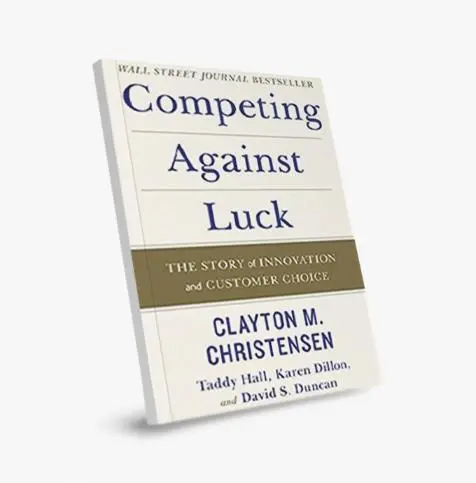
Competing Against Luck by Clayton M. Christensen is one of the clearest, deepest, and most transformative books for understanding how and why customers make decisions—and what it truly means to innovate successfully. In this work, Christensen consolidates and makes accessible the Jobs to Be Done theory, offering a powerful lens to rethink innovation, growth, and business strategy. The book starts from a fundamental premise: customers do not buy products for their features; they “hire” them to make progress in a specific context. Understanding that job—in its functional, emotional, and social dimensions—allows organizations to innovate far more predictably and effectively than traditional approaches based on segments or demographics.
“Customers don’t buy products; they hire them to get a job done.” — Clayton M. Christensen, Competing Against Luck
BOOK SUMMARY
The book develops the Jobs to Be Done theory as a central framework for understanding customer choice and guiding innovation in a systematic way. Christensen argues that most innovation initiatives fail not because of a lack of talent, resources, or technology, but due to a superficial understanding of the progress customers are actually trying to make in a specific situation. Traditional market research methods—based on demographic segmentation, preference surveys, or usage analysis—tend to capture symptoms rather than the real causes of choice. In contrast, the Jobs to Be Done approach makes it possible to identify with greater precision the forces that push customers to adopt or reject a solution, integrating functional, emotional, and contextual factors into a single coherent explanation.
One of the most emblematic examples in the book is the McDonald’s milkshake case, used to demonstrate how the same product can be “hired” for completely different jobs depending on context, timing, and customer circumstances. Through this case, Christensen shows that real competition rarely consists only of similar products within a category, but includes any alternative the customer considers valid to make the same progress. The example reveals that innovation is not about optimizing isolated attributes, but about understanding the full job and designing solutions that better fit into the customer’s real life.
Christensen also introduces the concept of competing against non-consumption, radically expanding the traditional notion of competition. Many of the most significant growth opportunities, he argues, emerge when companies identify important jobs that are currently underserved or not served at all. By focusing on these spaces, organizations can create new markets, reduce direct competitive pressure, and unlock genuine growth rather than fighting for share in mature markets.
Another relevant contribution of the book is the idea of building a portfolio of jobs, which allows companies to diversify their value propositions based on different jobs customers need to get done in different contexts. This approach helps avoid excessive dependence on a single product or segment and supports a more resilient innovation strategy. Christensen emphasizes that while products, technologies, and business models evolve constantly, the underlying jobs tend to remain remarkably stable over time—making them a reliable foundation for strategic decision-making.
Finally, the book addresses the organizational dimension of innovation, highlighting that adopting Jobs to Be Done requires changes in how processes are designed, metrics are defined, and decisions are made. Innovation stops being an occasional act of inspiration or unstructured creativity and becomes a disciplined process grounded in continuous customer learning, empirical evidence, and the deliberate design of solutions aligned with the progress people seek to make.
I recommend Competing Against Luck not only for the power of its ideas, but also for the enormous influence Clayton Christensen had—and continues to have—on how we understand innovation and business strategy. Christensen was my professor at Harvard Business School, and his ability to combine academic rigor, conceptual clarity, and practical applicability deeply shaped the way I think about business.
Clayton Christensen is widely recognized for foundational contributions such as the theory of disruptive innovation, but in this book he achieves something equally significant: he takes the Jobs to Be Done theory—originally developed by Anthony Ulwick from a more operational perspective—and develops it academically, validates it empirically, and popularizes it as a central strategic framework for understanding customer choice and business growth. Thanks to Christensen, Jobs to Be Done moves beyond being just a product innovation tool and becomes a core element of modern business theory.
From my experience, this book helps shift the axis of strategic conversation. It forces teams to stop debating which product to build or which feature to add, and instead start with a far more powerful question: what progress is the customer trying to make? That change in perspective dramatically reduces innovation risk and improves the quality of decisions at every level of the organization.
Within the Scalabl® methodology, Competing Against Luck is absolutely fundamental. Jobs to Be Done is the foundation of our stakeholder-centric view, where we understand that businesses exist within value networks and that innovation happens when an organization helps different actors in the system—customers, partners, teams, investors—better achieve their goals. Jobs to Be Done thus becomes the minimum unit of meaning for designing business models, operating models, and virtuous P&L structures.
I especially value that this book does not promise shortcuts or magic formulas. It offers something far more valuable: a solid conceptual framework for innovating with greater predictability, less blind intuition, and a deeper understanding of human behavior. For entrepreneurs, intrapreneurs, and leaders, this reading is key to stopping competition solely against other products and truly starting to compete against luck.
FREQUENTLY ASKED QUESTIONS
What is Jobs to Be Done according to Clayton Christensen?
In Competing Against Luck, Clayton Christensen and his co-authors explain that a Job to Be Done is the progress a person is trying to make in a given circumstance. Customers "hire" products or services to move towards that goal. That progress has functional, emotional and social dimensions: what they want to solve, how they want to feel, and how they want to be perceived.
How do you identify a customer's Job to Be Done?
Clayton Christensen's approach is to reconstruct concrete moments of choice: what was going on in the customer's life, what they wanted to change, which alternatives they considered and what got in the way. The conversations have to explore real experiences and the circumstances that drove or blocked the decision. That is how you understand the progress being sought, beyond the features the customer says they prefer.
How does Jobs to Be Done help identify your real competitors?
For Clayton Christensen, your competitors include every alternative a person considers in order to make the same progress, even if they belong to different categories. In the milkshake example from Competing Against Luck, breakfast on the morning commute could be solved with a milkshake, a banana or a bagel. Understanding the circumstances reveals which options an offering is really competing against.
Reading is the beginning. Applying is the leap.
At Scalabl you don't stop at the summary: you take the best business ideas to your own venture. Our flagship Entrepreneurship & Innovation Course: 10 years running, graduates in 50+ countries, 12 modules at your own pace.