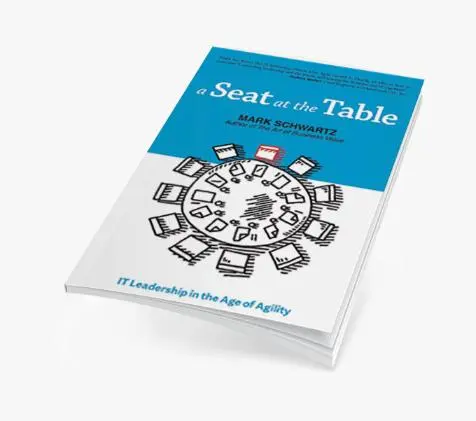
A Seat at the Table by Mark Schwartz presents a fundamental transformation in the role of technology leaders: moving from being order-takers to becoming strategic business partners, in an era where agility and digital innovation define business success.
“Technology can no longer sit at the kids’ table. It needs a seat at the table where strategic decisions are made.” — Mark Schwartz
BOOK SUMMARY
Mark Schwartz, former CIO of the United States Citizenship and Immigration Services and current strategist at Amazon Web Services, addresses one of the most critical challenges of the digital era: how IT leaders can and must evolve from a support function to a strategic position within the organization. The book dismantles the traditional mindset where the technology department receives requirements and executes them, proposing instead a model where IT actively participates in defining business strategy, agile governance, and value creation.
Schwartz integrates concepts from DevOps, agile methodologies, and digital transformation to build a compelling argument: organizations that treat IT as a cost center are destined to lose competitiveness. The author presents a new governance framework where technology investment is managed as strategic investment, where development teams have autonomy to experiment, and where the CIO becomes an agent of organizational change. The book is especially valuable for its practical approach, with concrete examples of how to implement these changes in real organizations, including Schwartz’s own experience in the U.S. federal government.
This book is essential for understanding how technology leadership has evolved over the past decades. IT is no longer a support function—it is the engine of business strategy. Schwartz’s argument that technology leaders need to be strategic partners resonates deeply with how we understand digital transformation at Scalabl®. Every business leader, not just those in technology, should understand this fundamental shift in organizational dynamics.
What makes this book particularly relevant is that Schwartz speaks not from theory but from the trenches. His experience leading the digital transformation of one of the most complex agencies in the U.S. government gives him unique credibility. In a world where technology defines who survives and who disappears, the question is no longer whether IT deserves a seat at the table, but whether the organization can survive without giving it that seat. This book helps explain why the answer is a resounding no.
Reading is the beginning. Applying is the leap.
At Scalabl you don't stop at the summary: you take the best business ideas to your own venture. Our flagship Entrepreneurship & Innovation Course: 10 years running, graduates in 50+ countries, 12 modules at your own pace.