How does Scalabl® integrate this book into its Startup methodology?
This is the foundation. At Scalabl®, we start from Personal Purpose and empower it with Mullins' Customer Funding and Taleb's risk reduction to achieve sustainable Virtuous Business Models.
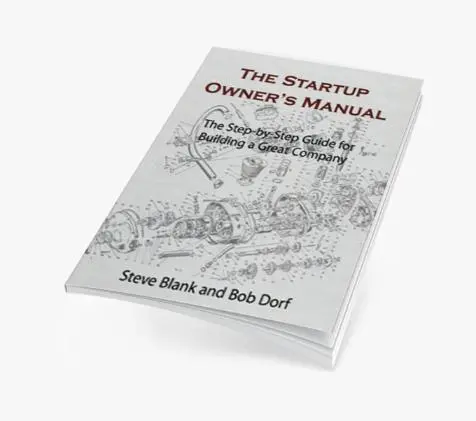
In "The Startup Owner's Manual," Steve Blank and Bob Dorf elucidate the Customer Development process, a foundational methodology for entrepreneurs that also laid the groundwork for the Lean Startup approach. Their comprehensive guide, rich in entrepreneurship tools and strategies, delves into critical techniques such as problem interviews, solution interviews, and the creation of Minimum Viable Products (MVPs). It empowers readers to master the art of founding startups, achieving Product-Market Fit, navigating challenges, and sidestepping common pitfalls. "A startup is a temporary organization designed to search for a repeatable and scalable business model." Steve Blank & Bob Dorf, The Startup Owner's Manual
BOOK SUMMARY
"The Startup Owner's Manual" by Steve Blank and Bob Dorf is a comprehensive guide that redefines the roadmap for entrepreneurial success. At its core, the book champions a customer-centric approach to startup development, diverging from traditional business strategies that focus more on product development and execution of fixed plans.
Central to the book is the concept of customer development, a four-stage model that insists on understanding and responding to customer needs. The stages include Customer Discovery, where entrepreneurs test hypotheses about potential customers; Customer Validation, ensuring the product meets market needs; Customer Creation, running a scalable, repeatable, marketing strategy; and Company Building, scaling the business into a sustainable organization.
Blank and Dorf emphasize learning over execution, advocating for a data-driven approach (both qualitative and quantitative) where decisions are based on validated learning from real customers rather than assumptions. This shift requires startups to be agile and flexible, ready to pivot based on customer feedback and changing market dynamics. The book also introduces the Business Model Canvas as a vital tool for visualizing and adapting business models.
Another key aspect of the book is the normalization of failure in the entrepreneurial journey, encouraging startups to view setbacks as learning opportunities. This aligns with the broader perspective that startups must operate within a larger ecosystem, considering factors like market trends, competitive landscapes, and regulatory environments.
The authors provide practical advice for different startup scenarios, acknowledging the unique challenges each faces. They also stress the importance of maintaining a long-term vision, balancing strategic foresight with operational efficiency.
In essence, "The Startup Owner's Manual" is not just a collection of methodologies; it's an empowering tool for entrepreneurs. It demystifies the startup process, offering a clear framework for building, scaling, and sustaining a successful startup. By blending theoretical frameworks with practical strategies and real-life examples, the book is an indispensable resource for anyone involved in or aspiring to enter the entrepreneurial world. It equips readers with the knowledge, tools, and confidence to navigate the startup ecosystem, making it an essential read for savvy freelancers, entrepreneurs, intrapreneurs, and business leaders.
Steve Blank is considered the father of modern entrepreneurship, and "The Startup Owner's Manual" is the fundamental work containing the pillars of his Customer Development methodology that sparked a true revolution in the business world, leading to many other movements, such as Eric Ries's "The Lean Startup."
Eric Ries was a disciple of Steve Blank and had him as a member of his board. In creating Lean Startup, he combined Customer Development as a business methodology with the values, principles, and techniques of Agile Frameworks designed for the optimization of software development. These techniques are in turn inspired by production, specifically the Toyota Production System (TPS), later called Lean Manufacturing in the United States.
Lean Startup is a movement originally driven by software development, not by business. The eponymous book incorporates, but does not detail, the stages of customer development. This is why many “gurus” and teachers of the Lean method around the world teach it without having read this foundational book by Steve Blank. This often leads to an incorrect application of the principles of Customer Development in startups and companies, and the subsequent frustration of entrepreneurs who prematurely accelerate the leap towards seeking investment to scale business models that have not been sufficiently validated.
In the current ecosystem, where investment rounds and accelerated growth at any cost are prioritized over the acquisition and application of existing knowledge and proven methodologies for building new businesses, this book can transform your life and career. "The Startup Owner's Manual" by Steve Blank and Bob Dorf is, in my opinion, the essential guide for entrepreneurship. It is a book that has deeply influenced my approach and thinking, especially in the development of the Scalabl® Methodology.
I dare to insist on the authors' recommendation about the way this book should be read, which should be considered as a manual, a detailed and meticulous guide, for frequent consultation, requiring study, dedication, and practice. Steve Blank and his co-author, Bob Dorf, have created and organized a powerful body of knowledge, eminently practical and applicable, and have had the generosity to offer it to the business world, which, in my opinion, has not yet received all the recognition it deserves.
For entrepreneurs, business leaders, and innovators, this book is a source of wisdom and inspiration, offering a path to navigate the complex, often tumultuous journey of building a business. I only have words of gratitude for these two authors, whose work and inspiration have transformed my life and that of many other entrepreneurs who are part of the global Scalabl® community. In a world where entrepreneurial methodologies evolve rapidly, "The Startup Owner's Manual" remains a timeless and indispensable resource.
Customer Development is a methodology created by Steve Blank to test the hypotheses behind a business model through customer contact and experimentation. In The Startup Owner's Manual, Blank and Bob Dorf lay out four stages: customer discovery, customer validation, customer creation and company building. The process makes it possible to correct assumptions before expanding a model that has not been proven yet.
What is the difference between customer discovery and customer validation?
In The Startup Owner's Manual, Steve Blank and Bob Dorf explain that discovery tests the hypotheses about customers, their problems and the proposed solution. Validation checks whether a repeatable and scalable sales process can be built. Favourable comments are not enough: what is needed is evidence of how customers are won and how revenue is generated. If that evidence is missing, the team goes back to discovery.
When is a startup ready to scale?
For Steve Blank and Bob Dorf, a startup is ready to scale once it has evidence of a repeatable and scalable business model. That requires understanding who buys, how customers are won and how to generate revenue that sustains the business. Early sales provide evidence, but the process has to be shown to repeat before spending increases significantly.
Reading is the beginning. Applying is the leap.
At Scalabl you don't stop at the summary: you take the best business ideas to your own venture. Our flagship Entrepreneurship & Innovation Course: 10 years running, graduates in 50+ countries, 12 modules at your own pace.