How does Scalabl® integrate this book into its Startup methodology?
Customer funding is the foundation of freedom. At Scalabl®, we turn Mullins' models into the 5 Rules of the Virtuous Model: collect before paying and positive cash flow to build antifragile businesses.
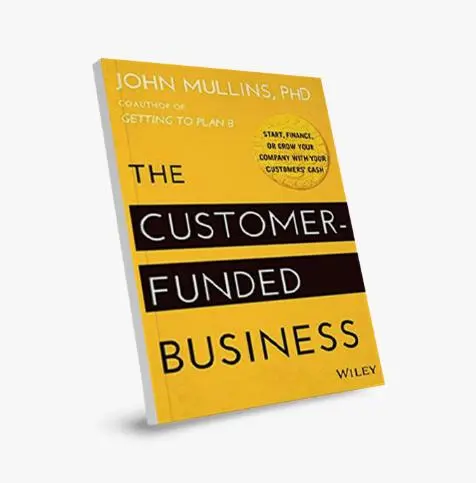
In "The Customer-Funded Business," John Mullins revolutionizes startup financing by advocating customer-funded models. Covering Matchmaker, Deposit, Subscription, Standardize-and-Resell, and Scarcity models, the book is a guide for entrepreneurs seeking innovative business strategies, customer-driven growth, and market adaptability. It underscores the significance of customer relationships and financial sustainability in the dynamic startup ecosystem.
"The vast majority of fast-growing companies never take any venture capital. So where does the money come from to start and grow their companies? From a much more agreeable and hospitable source, their customers." - John Mullins, The Customer Funded Business
BOOK SUMMARY
John Mullins' "The Customer-Funded Business" presents a revolutionary approach to startup financing, challenging traditional reliance on external funding sources. Instead, Mullins advocates for customer payments as a means to finance and grow a business. The book offers a comprehensive guide to five distinct customer-funded models, each adaptable to various industries and business contexts.
Matchmaker Model: This model, exemplified by companies like eBay and Expedia, involves connecting buyers and sellers without holding inventory. It benefits from low capital requirements and has gained popularity in the digital age. Mullins emphasizes the importance of trust and an effective platform in this model.
Deposit Model: Highlighted by FlightRaja’s experience in India, this model involves collecting advance payments or deposits for services. It's a strategic way to gain early funding without external sources, as seen in FlightRaja's rapid ascent to profitability.
Subscription Model: Illustrated by TutorVista, this model involves charging a recurring fee for continuous service. It ensures steady cash flow and capital efficiency, a strategy that has been successfully adapted in various sectors, including education and wellness.
Standardize-and-Resell Model: MapmyIndia demonstrates this model, where a product developed for one client is later resold to others. This approach emphasizes the importance of standardization and intellectual property.
Scarcity Model: Used effectively by Zara, this model leverages limited availability to motivate early customer purchases, focusing on rapid product turnover and supply chain management.
Mullins' book is not just theoretical; it provides practical tools and frameworks for implementing these models. It addresses industry-specific challenges and the importance of adapting the models to fit market needs and customer expectations. Mullins also discusses the ethical considerations of customer-funded models, emphasizing transparency and customer relationship management.
The book offers a global perspective, considering the adaptability of these models across different cultures and markets. It also highlights the role of technology in facilitating customer-funded businesses, particularly in the digital and e-commerce sectors.
"The Customer-Funded Business" is a groundbreaking work that encourages entrepreneurs to innovate in their funding strategies. By focusing on customer-centric growth and leveraging customer investments, Mullins offers a roadmap for building sustainable, flexible, and responsive businesses. His work is a testament to the importance of adaptability, market understanding, and ethical business practices in the modern entrepreneurial landscape.
In "The Customer-Funded Business," John Mullins resonates deeply with my critical view of the venture capital-led startup ecosystem. This book is an essential read for those who, like me, advocate for a shift in the traditional approach to startup financing, favoring a more customer-centric, sustainable model. Mullins' work aligns remarkably with Scalabl's methodology, emphasizing the importance of validating business models through customer interactions before making significant investments. It's a perspective that champions entrepreneurial resilience and financial prudence.
Mullins masterfully lays out various customer-funded models, advocating for strategies that reduce risk and avoid the often unsustainable reliance on external funding. This approach echoes my own experiences and beliefs in building businesses that are not just financially viable but also create real value for their customers. His emphasis on leveraging customer investments and relationships for growth mirrors the foundational principles of Scalabl, where we focus on nurturing businesses that are deeply rooted in understanding and serving customer needs.
Moreover, Mullins' insights into the practical applications of these models provide a roadmap for entrepreneurs and business leaders seeking innovative and ethical ways to finance and grow their ventures. His book is a testament to the power of customer-driven growth, challenging the conventional venture capital narrative and offering a more balanced, sustainable approach to entrepreneurship. I deeply admire John Mullins and this book is a must-read.
As a proponent of business models that prioritize customer engagement and ethical practices, I find "The Customer-Funded Business" not only inspiring but also aligned with the contemporary need for adaptability and long-term sustainability in business. This book is a crucial guide for anyone looking to navigate the modern entrepreneurial landscape with a strategy that values customer-centricity and financial self-sustainability. It's a narrative that enriches the reader's understanding of alternative financing models and inspires a creative and thoughtful approach to business strategy.
How can a business be funded with its customers' money?
John Mullins explains in The Customer-Funded Business that customer payments can fund the start and the growth of a company. The key lies in designing how you charge and how you deliver value: through advance payments, subscriptions or other models that reduce the money needed to operate. This makes it possible to lower or postpone the need for outside funding.
What are John Mullins's five customer-funded models?
John Mullins identifies five models: 1) matchmaker, connecting buyers and sellers and charging for facilitating transactions; 2) pay-in-advance, charging fully or partly before delivering; 3) subscription, receiving periodic payments for continued access to a product or service; 4) scarcity, offering limited availability that encourages immediate purchase and fast turnover; and 5) service-to-product, turning the work done for early customers into a product that can be sold to others.
Does funding yourself with customers mean giving up investors?
For John Mullins, funding yourself with customers reduces the dependence on investors and allows a better choice of when to bring in outside capital. Customer payments provide resources and evidence of demand, which can strengthen the entrepreneur's position when negotiating a later investment. The approach proposes exploring that source of funding first, without assuming that every business can grow on it alone.
Reading is the beginning. Applying is the leap.
At Scalabl you don't stop at the summary: you take the best business ideas to your own venture. Our flagship Entrepreneurship & Innovation Course: 10 years running, graduates in 50+ countries, 12 modules at your own pace.