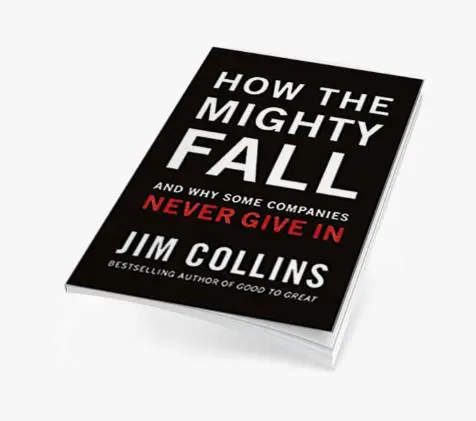
"How the Mighty Fall: And Why Some Companies Never Give In" by Jim Collins is the most important study on corporate decline ever conducted. After researching why some companies go from good to great (Good to Great), Collins asked: What happens when great companies fall? Can decline be detected and reversed? The result is an analysis of eleven companies that were great and fell, identifying five specific stages of decline that serve as an early warning system.
"Decline can be avoided. Decline can be detected. Decline can be reversed." - Jim Collins
BOOK SUMMARY
Collins and his team investigated companies that had been great (outperformed the market by 3x or more) and then fell significantly. They discovered that decline isn't random; it follows a predictable pattern of five stages:
STAGE 1: HUBRIS BORN OF SUCCESS
Decline begins not with failure, but with success. Great companies become arrogant, believing their success is an acquired right, not the result of strategic decisions and hard work. Symptoms:
Confusing "what" (right strategy) with "who" (we're geniuses)
Disdaining competition and the luck factors that contributed to their success
Believing past excellence guarantees future results
Ignoring that success creates the seeds of failure
STAGE 2: UNDISCIPLINED PURSUIT OF MORE
Arrogant from success, companies begin to diversify indisciplinately:
Enter businesses where they can't be the best
Grow beyond their capacity to manage effectively
Acquire companies without clear strategic synergy
Lose focus on their core business
Example: Circuit City expanding into used car financing while ignoring threats from Best Buy.
STAGE 3: DENIAL OF RISK AND PERIL
Signs of problems appear, but the organization ignores them or attributes them to external factors:
Explain bad results with "external factors" (economy, unfair competition)
Celebrate marginal results as great victories
Dismiss uncomfortable data that contradicts their narrative
Leaders isolated in their offices lose contact with operational reality
STAGE 4: GRASPING FOR SALVATION
The crisis is now evident, but instead of returning to fundamentals, they seek saviors:
Constantly change CEOs looking for a messiah
Attempt radical transformations without solid foundation
Desperately take on debt
Seek growth at any cost
This stage is dangerous because companies abandon what made them great in the first place.
STAGE 5: CAPITULATION TO IRRELEVANCE OR DEATH
Decline becomes irreversible:
Sold to competitors
Cease operations
Survive as a shadow of what they were
Companies that fell and recovered:
Collins identifies companies that fell to stage 4 but managed to recover:
IBM: After nearly going bankrupt in the 90s, returned to its fundamentals
Nucor: Steel company that faced crisis but maintained its culture of excellence
3M: Lost focus, then recovered its culture of disciplined innovation
Recovery factors:
Companies that recovered share characteristics:
1. Leaders who confront brutal reality: Don't deny problems
2. Return to fundamentals: Reinforce what made them great
3. Culture of excellence: Don't accept mediocrity
4. Organizational humility: Recognize that past success guarantees nothing
The point of no return:
Collins argues that between stages 3 and 4 there's a critical point. Before that point, decline can be reversed with determination. After, organizational and financial inertia makes recovery almost impossible.
Contrast with Good to Great:
While Good to Great identified success habits, How the Mighty Fall identifies failure patterns. Together they offer a complete map: what to do to succeed, and what to avoid to not lose it.
This book is essential because success is more dangerous than failure. When you're failing, you're alert. When you're successful, you become complacent. Collins demonstrates that great companies don't die from lack of opportunities; they die from excess of poorly managed opportunities.
I especially recommend it for its practical utility. The five stages are a diagnostic checklist. You can evaluate your company (or your personal career) at each stage. Are we in stage 1, believing we're invincible? In stage 2, diversifying indisciplinately? In stage 3, blaming external factors?
Stage 1 (hubris from success) is especially dangerous for startups that gain traction. Collins warns: growing success can lead to believing you're invincible, when in reality there was luck and external factors. Radical humility is the antidote against hubris.
Stage 2 (undisciplined pursuit of more) is especially relevant for successful startups. When money arrives, the temptation to "do it all" is irresistible. Collins warns: every new initiative must pass the test "Can we be the best in the world at this?" If the answer is no, don't do it.
Stage 3 (denial of risk) is where I see most companies fall. Numbers start dropping, but the CEO blames "the economy." Customers complain, but the team attributes it to "difficult customers." Collins says: when data contradicts your narrative, change your narrative. Not the data.
This book is the dark counterpart to Good to Great. If that one inspires you to build something great, this one warns you how not to lose it. Both are necessary.
The final message is hopeful: decline can be reversed, but it requires brutal honesty, quick decision-making, and willingness to return to the fundamentals that made you successful. There are no shortcuts, only disciplined work.
If you lead any organization that has had success, read this book now. It's preventive medicine against self-destruction.
Reading is the beginning. Applying is the leap.
At Scalabl you don't stop at the summary: you take the best business ideas to your own venture. Our flagship Entrepreneurship & Innovation Course: 10 years running, graduates in 50+ countries, 12 modules at your own pace.