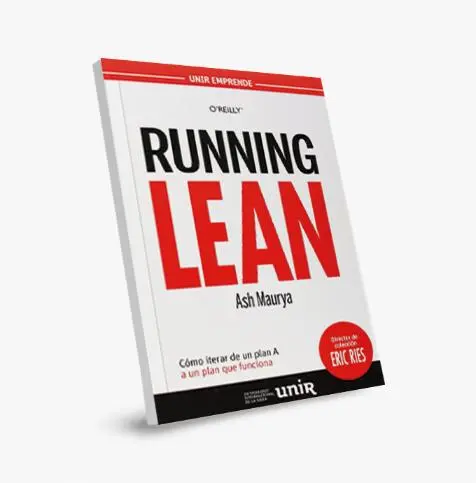
Running Lean by Ash Maurya is a practical guide that combines the principles of Lean Startup, Customer Development, and bootstrapping into a step-by-step framework for iterating from a Plan A to a plan that actually works. The book offers concrete tools—such as the Lean Canvas—so that entrepreneurs can systematically validate their business ideas before investing significant time and resources. It is one of the most useful and direct books available on how to build a viable business.
“Life is too short to build something nobody wants.” — Ash Maurya
BOOK SUMMARY
Running Lean is structured around three fundamental stages of the entrepreneurial process: documenting Plan A, identifying the riskiest parts of the plan, and systematically testing those assumptions. Maurya introduces the Lean Canvas as an alternative to the traditional business plan: a single page that captures the nine essential elements of a business model (problem, customer segments, unique value proposition, solution, channels, revenue streams, cost structure, key metrics, and unfair advantage). The power of the Lean Canvas lies in its simplicity: it forces the entrepreneur to articulate their hypotheses concisely and identify where the greatest risks lie.
The book details a three-phase validation process. The first is Problem/Solution Fit: does the problem you are trying to solve actually exist? Maurya teaches how to conduct problem interviews with potential customers, how to avoid the most common biases in those conversations, and how to interpret the signals. The second phase is Product/Market Fit: have you built something that people want enough to pay for? This is where MVPs (minimum viable products), traction metrics, and pricing experiments come in. The third phase is Scale: how to accelerate growth once the model has been validated.
What sets Running Lean apart from other entrepreneurship books is its rigorously practical approach. Each chapter includes templates, interview scripts, specific metrics, and clear criteria for deciding whether to pivot or persevere. Maurya does not theorize about innovation: he offers an operating manual that any entrepreneur can follow from day one. He also addresses topics that other books ignore, such as how to prioritize among multiple business ideas, how to manage founder time, and how to communicate progress to investors using validated learning metrics.
Running Lean is a pillar of the Scalabl® methodology. While Eric Ries’s The Lean Startup establishes the philosophy, Maurya makes it executable. The Lean Canvas is one of the tools we use most with our entrepreneurs because it achieves something difficult: forcing clarity without sacrificing nuance. I have seen hundreds of entrepreneurs try to explain their business for 30 minutes without managing to convey the core idea. When they complete a Lean Canvas, those same entrepreneurs can articulate their model in 2 minutes. That clarity is not an academic exercise: it is the difference between moving forward with focus and going around in circles.
What I value most about Maurya is that he understands the entrepreneur’s reality: limited resources, scarce time, and a constant urgency to find a working model before capital runs out. His focus on prioritizing the most critical risks first is essential. Most entrepreneurs spend months perfecting their product when the real risk is that nobody wants it. Running Lean teaches you to identify that kind of risk before writing a single line of code or investing a single dollar in development.
I recommend this book as required reading for anyone starting a project or business. It does not matter whether it is a tech startup or a traditional business: the validation process Maurya describes is universal. It is also valuable reading for those who have already read The Lean Startup and were left with the question: “How do I actually apply this?” Running Lean is the answer.
Reading is the beginning. Applying is the leap.
At Scalabl you don't stop at the summary: you take the best business ideas to your own venture. Our flagship Entrepreneurship & Innovation Course: 10 years running, graduates in 50+ countries, 12 modules at your own pace.