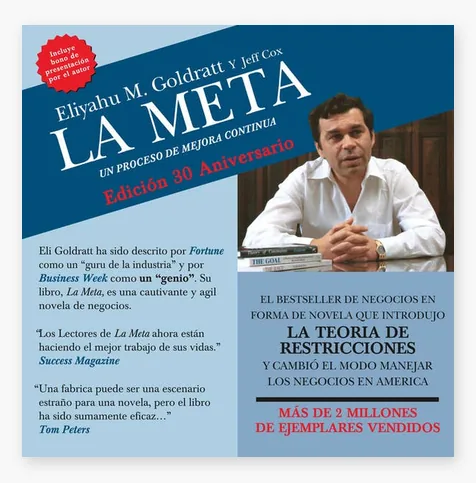
"The Goal", by Eliyahu M. Goldratt and Jeff Cox, is a business novel that teaches how to improve an organisation's results by identifying what limits them. Through the story of Alex Rogo, a plant manager who must prevent his factory from being shut down, it develops the foundations of the theory of constraints. It is a particularly useful read for entrepreneurs, leaders and operations managers who need to understand why an organisation can work intensely and still accumulate delays, inventory and financial difficulties. Its contribution is to connect everyday decisions with the result of the business.
A SHORT SUMMARY OF THE BOOK
Alex Rogo runs a factory that accumulates delays, inventory and losses, even though its workers and machines always seem to be busy. Facing closure, his conversations with Jonah, a former professor, lead him to question how he measures productivity. For the for-profit company in the novel, the goal is to make money now and in the future. Every operational decision must be examined by its contribution to that objective.
THREE MEASURES THAT CONNECT OPERATIONS WITH THE BUSINESS
To connect everyday work with results, Jonah introduces three measures:
Measure
What it represents
Throughput
The rate at which the system generates money through sales.
Inventory
The money invested in buying things the company intends to sell.
Operational expense
The money it spends to turn that inventory into throughput.
Looking at them together makes it possible to understand why producing more parts can tie up resources without improving the business.
THE HIKE, THE BOTTLENECKS AND THE PACE OF THE SYSTEM
During a hike with a group of boys, Alex finds a way to understand what is happening in the plant. Differences in speed create gaps that keep widening, and those walking behind depend on the movement of those ahead. Something similar happens in the factory: activities depend on one another and their times vary. Delays can accumulate, while the chance to make up time is limited by the capacity of the following stages. Planning with averages alone hides those difficulties.
This observation helps the team identify the bottlenecks: resources whose capacity is equal to or lower than the demand placed on them. Alex and his colleagues reorganise priorities, protect the time of those machines and prevent them from processing defective or unnecessary parts. They discover that making better use of those resources can improve the result of the whole plant.
They also find that keeping the remaining machines producing at full capacity creates pile-ups and makes it harder to complete orders. Releasing materials should follow the pace the system can sustain. From there comes a central distinction in the book: activating a resource means putting it to work; using it productively requires that work to contribute to the goal. The efficiency of each department, considered in isolation, can lead to decisions that harm the whole.
A PROCESS OF ONGOING IMPROVEMENT
From these experiences, the team formulates a process of ongoing improvement: identify the constraint, exploit it, coordinate the remaining resources around it, elevate its capacity and examine the system again once it has been overcome. The constraint can move from a machine to market demand or to the operating rules themselves. Improving therefore also requires revisiting decisions that used to work, and preventing inertia from turning a past solution into a new obstacle.
The novel develops this learning through questions, observations and tests that allow the team to review its assumptions. Its contribution combines a method for guiding improvement with a way of reasoning about problems: understanding the relationships between the parts, looking for what limits the result, and evaluating changes by their consequences for the whole organisation.
What I value most about The Goal is how it helps us look at the company as a set of interdependent activities. It invites us to ask what effect each decision has on the business, and to recognise that strong performance in one area can coexist with poor overall results.
I find its way of guiding priorities especially useful. In any organisation there are always many things to improve, but their contribution is not equivalent. Understanding what is limiting the result makes it possible to decide where to focus attention and how to coordinate everyone else's work.
From the Scalabl® perspective, this view helps connect the operating model with the economic results of the business. It also invites us to review indicators and incentives: which behaviours we are encouraging and what consequences they have for the whole.
The way the book teaches deserves a special mention. Jonah uses questions so that Alex and his team examine their assumptions, observe what happens and build their own explanations. That process turns reading into an exercise in reasoning that we can carry into our own decisions.
I recommend The Goal to those who want to improve their ability to diagnose problems, set priorities and work with others. Although it takes place in a factory, it offers valuable questions for examining any organisation: what we are trying to achieve, what limits us and what we need to change in order to move forward.
FREQUENTLY ASKED QUESTIONS
What is the theory of constraints explained in The Goal?
The theory of constraints focuses improvement on whatever limits a system's progress towards its goal. Goldratt proposes identifying that constraint and coordinating the remaining resources around it. The limitation may lie in productive capacity, in demand or in the operating rules. Improving each area separately does not guarantee a better overall result.
What are the five steps of ongoing improvement in The Goal?
The five steps are: 1) identify the system's constraint; 2) exploit it, making better use of its available capacity; 3) subordinate the remaining resources to that decision; 4) elevate it, expanding its capacity; and 5) repeat the process once the constraint has been overcome. The last step requires revisiting earlier decisions so that inertia does not become a new constraint.
Why can keeping every machine busy reduce productivity?
Because producing beyond what the system can absorb accumulates inventory without increasing sales, and can delay orders. In The Goal, Goldratt distinguishes between activating a resource and using it to move towards the goal. Productivity depends on the contribution to the overall result, not on the percentage of time each machine stays busy.
Reading is the beginning. Applying is the leap.
At Scalabl you don't stop at the summary: you take the best business ideas to your own venture. Our flagship Entrepreneurship & Innovation Course: 10 years running, graduates in 50+ countries, 12 modules at your own pace.
No comments yet. If you are an alumni, start the conversation.
This space is for alumni only
Alumni are those who have taken one of Scalabl®'s programs: the Entrepreneurship and Innovation Course, one of the learning communities, a Mastermind or a program for companies and institutions. With platform access you can comment on content, reply to other alumni and connect with more than 3,000 graduates in over 50 countries.