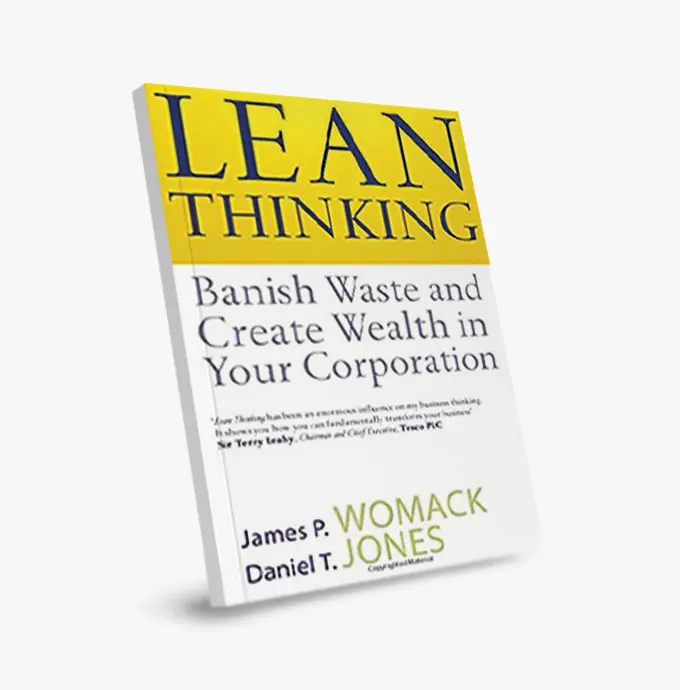
Lean Thinking explains how companies can radically improve performance by rethinking how work is designed, executed, and improved. The book begins by defining value strictly from the customer’s perspective, challenging organizations to stop optimizing internal efficiency at the expense of customer outcomes. From there, Womack and Jones introduce value stream mapping as a core diagnostic tool: a way to visualize every step required to deliver a product or service and to clearly distinguish value-creating activities from waste.
A central theme is the principle of flow. Traditional organizations are structured around departments, handoffs, and batch processing, which create delays, rework, and inefficiencies. Lean Thinking argues for redesigning processes so that work flows smoothly across functions, reducing interruptions and accelerating the delivery of value. Closely connected to this is the idea of pull, where production and service delivery are triggered by real customer demand rather than forecasts. This shift reduces inventory, shortens lead times, and increases responsiveness.
The fifth principle, perfection, emphasizes that Lean is not a one-time transformation but an ongoing pursuit. Continuous improvement (kaizen) becomes a daily practice, supported by transparency, measurement, and problem-solving at all levels of the organization. Importantly, the book highlights that Lean is not primarily a set of tools, but a management system and cultural transformation that requires leadership commitment and employee engagement.
Throughout the book, Womack and Jones illustrate these principles with real-world cases across manufacturing, services, logistics, and healthcare, demonstrating that Lean Thinking is not industry-specific. Its power lies in its universality: wherever there are processes, customers, and value creation, Lean principles can be applied to improve outcomes.
I consider Lean Thinking a fundamental book for anyone serious about building sustainable, high-performing organizations. What makes it especially powerful is that it goes far beyond operational efficiency—it offers a new way of seeing the organization as a system of value creation. In many companies, strategy, operations, and financial results are treated as separate conversations. Lean Thinking shows how they are inseparable.
From a Scalabl® perspective, this book is essential because it clarifies something often misunderstood: Lean is not about cost-cutting or doing more with less in a narrow sense. It is about designing systems where value flows naturally to customers and waste is exposed and eliminated as a consequence. This systemic view aligns deeply with how we think about business models, operating models, and P&L as interconnected elements within broader value networks.
Another reason I strongly recommend this book is its emphasis on people and learning. Lean organizations are not built by experts designing perfect processes in isolation; they are built by empowering teams to see problems, experiment, and improve continuously. This is critical in a volatile world where no process remains optimal for long. Organizations that learn faster than their environment gain a durable advantage.
Lean Thinking also provides a solid foundation for innovation. By stabilizing and improving core processes, companies create the capacity—time, energy, and clarity—to explore new opportunities. In that sense, Lean is not the opposite of innovation; it is often a prerequisite for it. Without operational clarity, innovation becomes chaotic and unsustainable.
Finally, I value this book because it teaches discipline without rigidity. The pursuit of perfection is not about control, but about curiosity, humility, and long-term thinking. For entrepreneurs, intrapreneurs, and leaders seeking to build resilient organizations that can scale without losing coherence, Lean Thinking is not optional reading—it is foundational.
Reading is the beginning. Applying is the leap.
At Scalabl you don't stop at the summary: you take the best business ideas to your own venture. Our flagship Entrepreneurship & Innovation Course: 10 years running, graduates in 50+ countries, 12 modules at your own pace.