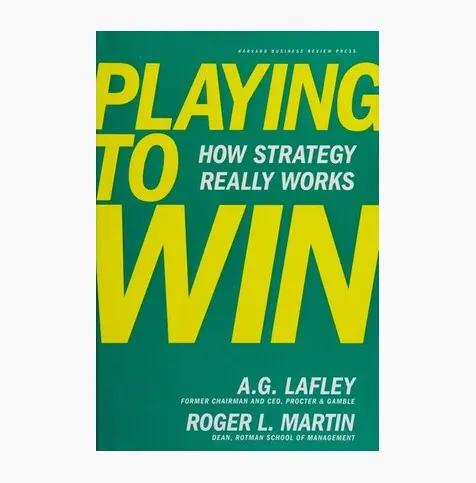
Discover "Playing to Win," Roger L. Martin's masterpiece that revolutionized how companies approach corporate strategy. This book has become required reading for executives, entrepreneurs, and business consultants seeking to understand how strategic decisions really work in the world's leading organizations. Martin, recognized as one of the most influential thinkers in management, breaks down the strategy creation process that Procter & Gamble used to transform into one of the most successful companies on the planet. Through a practical and accessible framework, the author demonstrates that effective strategy isn't about endless analysis or perfect plans, but about making difficult choices that enable winning in the marketplace.
BOOK SUMMARY
"Playing to Win" presents a framework of five interconnected questions every organization must answer to develop effective strategy:
1. What is your winning aspiration? - Defining clearly what "winning" means
2. Where will you play? - Choosing specific markets, segments, and channels
3. How will you win? - Developing the unique value proposition
4. What capabilities must you have? - Identifying skills and resources needed
5. What management systems do you need? - Establishing processes to sustain capabilities
This book is essential for any entrepreneur or executive who wants to stop improvising and start building companies with clear purpose. What I value most is its executive simplicity: Martin doesn't give you abstract theories, but a practical framework you can apply from day one. The five questions are a powerful filter: if you can't answer them clearly, you don't have strategy, you have wishes.
FREQUENTLY ASKED QUESTIONS
What is the difference between having goals and having a strategy?
For A. G. Lafley and Roger L. Martin, goals express what an organisation wants to achieve; strategy articulates the choices that would allow it to get there. In Playing to Win, that means deciding where to compete, how to build an advantage, and which capabilities and systems will sustain those decisions. Aspiring to grow or to lead a market does not, on its own, explain how to do it.
What are the five strategic questions in Playing to Win?
A. G. Lafley and Roger L. Martin organise strategy around five questions: 1) what is our winning aspiration?; 2) where will we play?; 3) how will we win?; 4) what capabilities do we need?; and 5) what management systems must sustain those capabilities? The answers have to reinforce one another: setting an ambition requires choosing a field of play and a way of competing that the organisation can actually sustain.
What does choosing where to play and how to win mean?
In Playing to Win, A. G. Lafley and Roger L. Martin present two inseparable choices. Where to play defines the customers, markets and channels you will compete in. How to win explains the advantage that will let you succeed there. They have to be thought through together: an attractive market is not enough if the company has no convincing way of competing in it.
Reading is the beginning. Applying is the leap.
At Scalabl you don't stop at the summary: you take the best business ideas to your own venture. Our flagship Entrepreneurship & Innovation Course: 10 years running, graduates in 50+ countries, 12 modules at your own pace.