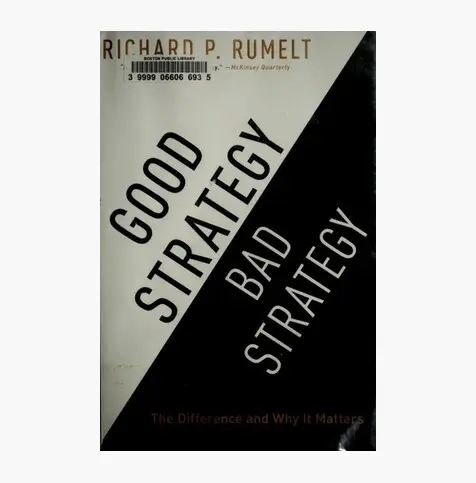
"Good Strategy Bad Strategy" by Richard P. Rumelt is a foundational work that has redefined how leaders, executives, and entrepreneurs understand and execute business strategy. In a corporate landscape saturated with ambiguous plans, wish lists disguised as objectives, and PowerPoints full of buzzwords, Rumelt offers a raw and honest analysis of what separates effective strategies from those that fail spectacularly. This book has become essential reading for CEOs, consultants, investors, and business students seeking to develop genuine strategic thinking. The author, recognized as one of the world's foremost experts on strategy, dissects with surgical clarity the most common mistakes organizations make when formulating their plans and provides an actionable framework for building strategies that actually work. It is particularly valuable for those who need to cut through corporate rhetoric and focus on precise diagnosis, coherent policies, and concrete actions that generate measurable and sustainable results over time.
BOOK SUMMARY
Good Strategy Bad Strategy is a book that demystifies business strategy by separating the wheat from the chaff. Rumelt argues that true strategy is not a lengthy document or a set of aspirations, but a coherent response to a specific challenge.
Key Concepts:
1. The kernel of good strategy: Three essential elements:
- Diagnosis: An explanation of the nature of the challenge, simplifying situational complexity
- Guiding policy: An overall approach to dealing with the challenge that leverages advantages and avoids weaknesses
- Coherent actions: Executable steps that implement the guiding policy in a coordinated manner
2. The anatomy of bad strategy: Rumelt identifies four warning signs:
- Fluff: Vague language pretending to be expertise
- Failure to face the challenge: Confusing goals or aspirations with strategy
- Mistaking goals for strategy: Presenting financial targets as if they were strategic approaches
- Bad strategic objectives: A mere laundry list of "things to do" without coherence or prioritization
3. The leverage of strategy: How to concentrate scarce resources at points where they can generate disproportionate impact, creating sustainable competitive advantages.
4. Chain-linked advantages: When a company achieves multiple elements of its business model reinforcing each other, creating difficult-to-replicate imitation barriers.
5. Thinking in structures: The ability to see patterns in complex situations and recognize true strategic inflection points.
6. Emergent vs. deliberate strategy: How the best strategies often emerge from experimentation and learning, not just from the master plan.
As an entrepreneur who has had to distinguish between what sounds good in an investor meeting and what actually moves the needle in business, this book was a revelation. Rumelt doesn't write to impress; he writes so you understand.
The distinction between "good" and "bad" strategy helped me recognize my own mistakes. For years I confused ambitious goals with clear strategy. "We want to be market leaders" is not strategy; it's a wish. Strategy is the specific path you choose to get there, recognizing your limitations and exploiting the real opportunities in front of you.
I make it required reading in all our Scalabl programs because strategic clarity is what separates companies that scale from those that stagnate. In a world where everyone wants to "disrupt" without knowing how, Rumelt is the perfect antidote to magical thinking.
Reading is the beginning. Applying is the leap.
At Scalabl you don't stop at the summary: you take the best business ideas to your own venture. Our flagship Entrepreneurship & Innovation Course: 10 years running, graduates in 50+ countries, 12 modules at your own pace.