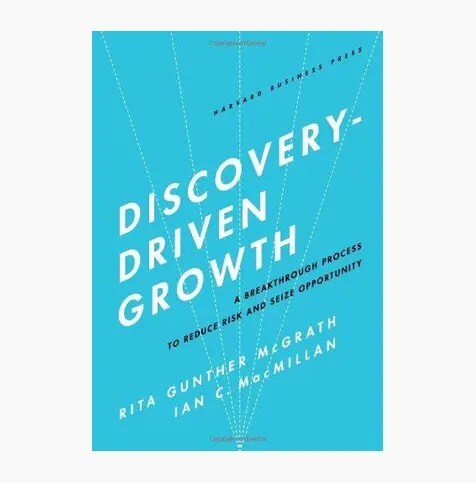
In a business world where uncertainty is the only constant, "Discovery-Driven Growth" by Rita Gunther McGrath and Ian C. Macmillan offers a revolutionary framework for transforming how organizations approach growth and innovation. This book has become required reading for entrepreneurs, executives, and corporate professionals seeking to balance the need to innovate with intelligent risk management. Unlike traditional approaches that demand detailed plans before acting, this methodology proposes an iterative discovery process where each step generates valuable information to reduce uncertainty. Companies adopting this approach learn to convert assumptions into verifiable knowledge, allowing them to pivot or persevere with concrete data rather than intuition. It is especially relevant for early-stage startups, established corporations seeking reinvention, and innovation teams needing to justify their investments to executive leadership.
BOOK SUMMARY
Discovery-Driven Growth introduces a systematic approach to managing growth projects under uncertainty. The authors, renowned Wharton academics, develop a practical framework that allows companies to explore new opportunities without committing excessive resources prematurely.
Key Concepts:
1. Discovery-driven planning vs. conventional planning: Traditional planning assumes the future is predictable and seeks to optimize resources toward defined goals. Discovery-driven planning recognizes that in innovative projects, unknowns exceed knowns, so it prioritizes learning fast and cheaply.
2. The four stages of the process:
- Formulation: Articulate the vision and define the critical tests needed
- Checkpoint design: Establish milestones where the decision to continue, pivot, or abandon will be made
- Testing and learning: Execute experiments designed to validate critical assumptions
- Scaling: Only after validation, commit significant resources
3. Discovery-driven planning document: A tool that organizes assumptions, validation metrics, required resources, and decision criteria at each stage.
4. Strategic options portfolio management: Treating early-stage projects as real options, where initial investment buys the right but not the obligation to invest more if results are promising.
5. Search for the "something that needs to be believed": Identifying the most critical and risky assumptions that must be validated first to drastically reduce project uncertainty.
As a serial entrepreneur and CEO of Scalabl, I have lived the tension between the need to move fast and the responsibility not to burn capital on unvalidated ideas. "Discovery-Driven Growth" gave me a language and structure for what we intuitively do in the best startups: making decisions based on learning, not ego or inertia.
This book is especially valuable because it translates rigorous academic concepts into practical tools you can apply tomorrow. The notion of treating uncertain projects as "strategic options" changed my way of evaluating opportunities and communicating them to investors and teams.
I recommend it to all participants in our programs because it teaches you to be ambitious without being irresponsible. At Scalabl we believe in smart growth, and this methodology is exactly that: a system for growing disciplined when navigating unknown waters.
Reading is the beginning. Applying is the leap.
At Scalabl you don't stop at the summary: you take the best business ideas to your own venture. Our flagship Entrepreneurship & Innovation Course: 10 years running, graduates in 50+ countries, 12 modules at your own pace.
Nathan Furr, Jeff Dyer, Curtis Lefrandt: Examines how leaders obtain resources for uncertain projects, the logical next step after planning for discovery.