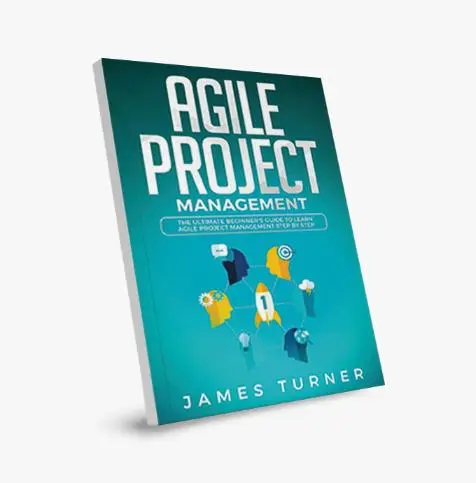
Agile Project Management by James Turner is a practical and structured guide to understanding and applying agile principles to project management in complex and uncertain environments. The book is aimed at freelancers, entrepreneurs, intrapreneurs, and leaders who need to deliver value continuously, adapt quickly to change, and improve collaboration within teams. Turner starts from a clear premise: in dynamic contexts, traditional rigid planning approaches are insufficient, and agility becomes a strategic capability rather than a one-off methodology.
“Responding to change over following a plan.” — The Agile Manifesto, referenced and applied in Agile Project Management by James Turner
BOOK SUMMARY
The book begins by establishing the foundations of agile project management, highlighting the importance of breaking complex projects into small, prioritizable, and deliverable units. This approach helps reduce risk, incorporate early learning, and adjust the project’s direction as context evolves or customer needs change. Incremental delivery is presented not merely as a technique, but as a conscious way of managing uncertainty.
Turner dedicates a significant portion of the book to explaining the origin and evolution of agile methodologies, placing them in historical context and showing how they emerged as a response to the limitations of traditional project management models. By contrasting both approaches, the author emphasizes that agility does not mean a lack of discipline, but rather a different kind of discipline—one based on short cycles, continuous feedback, and constant learning.
One of the book’s central contributions is its clear explanation of the principles that underpin successful agile projects, including customer focus, close collaboration with stakeholders, and the ability to respond to change over rigid adherence to a plan. These principles are translated into concrete practices that help teams prioritize better, make informed decisions, and stay aligned with business objectives.
An important section is devoted to the most widely used agile frameworks, such as Scrum and Kanban. Turner presents them in an accessible way, explaining not only their mechanics but also the logic behind them. The book shows how these frameworks can be adapted depending on the type of project, team size, and organizational context, avoiding a dogmatic adoption of agile practices.
The author also addresses key topics such as estimation, quality control, and roles and responsibilities within agile teams. He emphasizes the importance of empowering teams by giving them autonomy to organize their work, while maintaining transparency and accountability. This balance is presented as a critical factor in improving both project outcomes and team motivation.
Overall, the book functions as a practical manual that combines conceptual foundations with actionable guidance. It does not promise magic solutions or shortcuts, but instead offers a clear framework for implementing agile project management in a conscious, progressive way aligned with business goals.
I recommend Agile Project Management because it is an honest and well-structured book for those who need to understand agility beyond trends and buzzwords. It does not limit itself to describing tools, but explains why agility works in environments where uncertainty, change, and complexity are the norm.
From my experience, many teams “adopt” agile practices without understanding the principles that sustain them, which leads to frustration and poor results. This book helps avoid that mistake by providing a solid foundation for making better decisions about how to manage projects, teams, and expectations.
I especially value Turner’s focus on continuous learning and value delivery—two ideas that are also central to Scalabl® thinking. Agile project management is not just a way to execute better, but a way to learn faster and reduce risk before scaling.
For entrepreneurs and intrapreneurs, this book is particularly useful because it offers a shared language to coordinate small teams, prioritize effectively, and move forward without relying on rigid plans that quickly become obsolete. For leaders, it brings clarity on how to create environments where autonomy and accountability coexist in a healthy way.
Ultimately, it is a highly recommended read for anyone looking to improve how their teams and projects work, understanding agility as a key organizational capability rather than just a set of isolated practices.
Reading is the beginning. Applying is the leap.
At Scalabl you don't stop at the summary: you take the best business ideas to your own venture. Our flagship Entrepreneurship & Innovation Course: 10 years running, graduates in 50+ countries, 12 modules at your own pace.