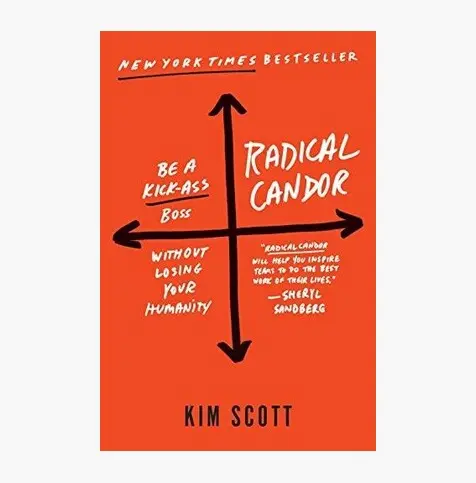
Radical Candor, by Kim Scott, is a leadership book that proposes combining personal care for people with the ability to challenge them directly. Its radical candor approach helps leaders give clear, respectful feedback, develop people and improve team collaboration.
Leading means talking about what works, pointing out what needs to improve and understanding what motivates each person. Many management problems appear when those conversations are avoided, turn aggressive or come too late.
The book covers feedback, professional development and how to organize work to achieve collective results. It offers tools for anyone who needs to guide a team, make decisions and hold difficult conversations with respect and responsibility.
BOOK SUMMARY
What is radical candor?
Radical candor means showing that the other person matters to us and, at the same time, saying clearly what they need to hear. It requires building relationships where it is possible to recognize contributions, point out problems and question ideas.
Caring personally means understanding that every team member has their own motivations, circumstances and aspirations. Challenging directly means offering honest, specific observations, even when the conversation is uncomfortable.
Both dimensions must be present. Candor needs humility: our perspective may be incomplete, and we must be willing to hear an answer that changes our interpretation. The official Radical Candor framework.
What are the four quadrants of Radical Candor?
Quadrant
Care personally
Challenge directly
Typical behavior
Radical candor
High
High
Saying clearly what is needed while showing genuine interest in the person.
Obnoxious aggression
Low
High
Criticizing or demanding without consideration for the other person.
Ruinous empathy
High
Low
Avoiding a necessary observation so as not to hurt feelings.
Manipulative insincerity
Low
Low
Hiding what one thinks out of convenience, indifference or self-protection.
These quadrants help examine behaviors and conversations. The same person may communicate in different ways depending on the situation. The two dimensions of the model.
What is ruinous empathy?
Ruinous empathy appears when the wish to spare someone discomfort leads us to withhold information they need in order to improve. The immediate relief can give way to bigger problems: repeated mistakes, unmet expectations or decisions that arrive without warning.
Kim Scott presents the HIP approach as a guide for offering praise and criticism:
Humble: acknowledge that our interpretation may be wrong.
Helpful: make sure the conversation helps the other person improve.
Immediate: speak close to the moment it happened.
In person: make dialogue easier and observe how the message is received.
Criticize in private, praise in public: adapt the setting, taking into account the preferences of the person receiving the praise.
Focused on the work: describe behaviors and results, avoiding judgments about personality.
The usefulness of feedback depends on its clarity and on how the other person understands it. Listening to their response allows us to correct interpretations and adjust the conversation. Feedback principles explained by Kim Scott.
What is the difference between rock stars and superstars?
Scott separates performance from growth trajectory. Two people can do excellent work and need different opportunities.
People in rock star mode bring stability and mastery of their work, with a gradual growth trajectory. People in superstar mode need a faster expansion of their challenges and their contribution. Both matter to the team.
These trajectories change with circumstances and life stages. Knowing them helps assign responsibilities and recognize contributions without imposing the leader's ambitions on everyone else.
Growing does not necessarily mean being promoted or becoming a manager: a person can greatly expand their contribution from a specialized role. Growth and stability in teams.
How to organize career conversations?
Career conversations help understand what each team member is looking for. The process developed by Russ Laraway, which Scott incorporates into her approach, proposes three conversations:
Life story: understand the experiences and decisions that reveal motivations.
Dreams: explore which professional futures interest the person.
Action plan: identify the learning, projects and experiences that will help them move forward.
The goal is to connect everyday work with a direction that makes sense for the person. These conversations require listening without assuming that everyone wants to follow the same path. Career conversations.
How does the GSD wheel work?
The GSD wheel organizes collaboration in seven steps: listen, clarify, debate, decide, persuade, execute and learn.
Listening gathers ideas. Clarifying them helps understand them before evaluating them. Debating them reveals problems and alternatives. Then it is necessary to decide and explain the reasons to those who will take part in the execution.
Executing takes time and coordination. Learning means reviewing the results and accepting that a decision may need adjustments.
Leadership makes that journey possible: it enables participation, clarifies how decisions are made and protects the time needed to do the work. Skipping stages creates problems later; stretching them indefinitely also has a cost. The GSD wheel.
I recommend Radical Candor because it helps think about leadership through everyday responsibilities: listening, saying what needs to be said, understanding people and creating the conditions for them to do good work.
Ruinous empathy raises an especially useful question: are we really helping someone when we avoid an uncomfortable conversation? Silence can leave a person without the information they need to learn or fix a problem. Speaking with respect and clarity is part of our responsibility.
I also find the distinction between performance and growth trajectory valuable. An organization needs to recognize different aspirations and life stages. Someone who wants to deepen their specialty can contribute as much as someone who seeks ever bigger challenges. Understanding those differences allows us to support people better and build stronger teams.
From the Scalabl® perspective, the book offers tools to connect learning, collaboration and results. Applying it requires observing how we talk to each other, what opportunities we give others and how we respond when our own ideas are questioned.
I recommend it to entrepreneurs, leaders and professionals who work with other people and want to improve those relationships. It is a book to take into concrete conversations: asking for criticism, recognizing a contribution, addressing a pending problem or understanding what someone wants to build with their career.
Reading is the beginning. Applying is the leap.
At Scalabl you don't stop at the summary: you take the best business ideas to your own venture. Our flagship Entrepreneurship & Innovation Course: 10 years running, graduates in 50+ countries, 12 modules at your own pace.