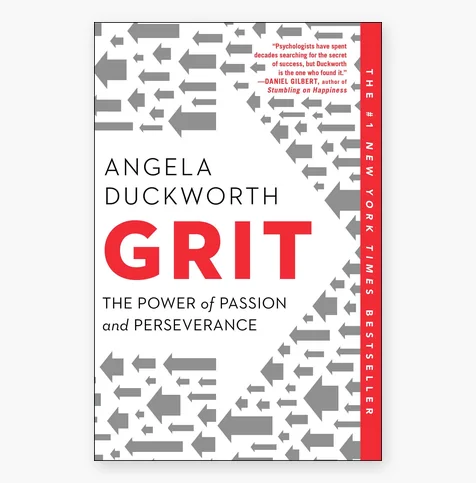
"Grit", by Angela Duckworth, explores how passion and perseverance sustained over time contribute to the development of our abilities. Drawing on research and interviews, the author explains the role of effort in turning talent into skill, and skill into achievement. It is a read for entrepreneurs, leaders, educators and professionals interested in continuous learning: it helps you understand how to deepen your interests, sustain practice and keep improving when difficulties appear or progress is slow to show.
BOOK SUMMARY
Angela Duckworth investigates the relationship between talent, effort and achievement through studies with military cadets, students and spelling-bee competitors, among other groups. Her findings show that initial ability explains only part of what people go on to accomplish. The continuity of the work also helps explain their trajectories.
The concept of grit brings together passion and perseverance for long-term goals. Passion means a sustained direction of interest, one that deepens over time. Perseverance makes it possible to keep working when progress is slow or setbacks appear. Both dimensions connect everyday effort with something the person considers important.
To explain the role of effort, Duckworth proposes a model in which it intervenes twice: it helps turn talent into skill, and it turns that skill into results. Having potential and developing it are different processes; learning and applying what you have learned both require sustained work.
The book identifies four elements that can be cultivated: interest, practice, purpose and hope. Interest is discovered and deepened; practice aims at improvement; purpose connects the work to a contribution beyond personal gain; and hope sustains the search for ways forward when difficulties arise.
This development also has a social dimension. Teachers, family, mentors and peers can offer support, expectations and examples that help sustain learning. Sharing difficulties, asking for help and acknowledging progress are part of that process.
Perseverance allows for revisiting the means you have chosen. Duckworth distinguishes higher-order goals from the actions and projects that serve them: changing a strategy can be what lets you hold a worthwhile direction. She also recognises that opportunity and circumstance influence outcomes. Personal effort plays a significant role, but it does not guarantee success.
I recommend Grit because it connects three ideas I consider fundamental to our development: passion for what we do, perseverance sustained over time, and continuous learning. Developing our abilities requires finding something that interests us deeply and devoting effort to getting better, even when progress is slow.
I find Angela Duckworth's explanation especially valuable: how effort turns talent into skill, and how those skills, put into practice with effort, lead to results. That view invites us to take an active part in our own development: to practise, seek feedback, correct course and keep learning.
Passion gives us a direction we want to go deeper into. The more we know a field, the more challenges and reasons to get involved we discover. Perseverance is what sustains that journey beyond the initial enthusiasm, carries us through difficulty and gives the learning time to accumulate.
From the Scalabl® perspective, I find a direct connection here with continuous learning. Building capability is work that unfolds over a lifetime. Every experience can widen what we know how to do, if we stop to understand it and work on what we need to improve.
I recommend it to those who want to develop their talent and commit to their own growth. The book invites us to ask what matters enough to us to devote years of learning to it, and what we are doing today to move in that direction.
FREQUENTLY ASKED QUESTIONS
What does grit mean according to Angela Duckworth?
Angela Duckworth defines grit as passion and perseverance for long-term goals. It combines a sustained direction of interest with the willingness to keep working through difficulty and slow progress. It describes the commitment that lets a person go deeper into something that matters to them over time.
What is the relationship between talent, effort and skill in Grit?
In Grit, Angela Duckworth proposes that talent, developed through effort, becomes skill. In turn, applying that skill with effort is what produces results. That is why effort intervenes twice in her model: when learning, and when using what has been learned.
How can grit be developed?
Angela Duckworth proposes cultivating interest, practice, purpose and hope: going deeper into what interests us, practising in order to improve, connecting the effort to a contribution, and looking for ways forward in the face of obstacles. These elements help sustain learning and commitment to long-term goals.
Reading is the beginning. Applying is the leap.
At Scalabl you don't stop at the summary: you take the best business ideas to your own venture. Our flagship Entrepreneurship & Innovation Course: 10 years running, graduates in 50+ countries, 12 modules at your own pace.
No comments yet. If you are an alumni, start the conversation.
This space is for alumni only
Alumni are those who have taken one of Scalabl®'s programs: the Entrepreneurship and Innovation Course, one of the learning communities, a Mastermind or a program for companies and institutions. With platform access you can comment on content, reply to other alumni and connect with more than 3,000 graduates in over 50 countries.