
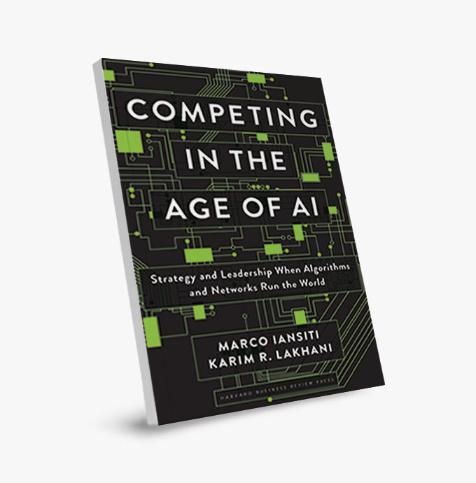
from Marco Iansiti and Karim R. Lakhani
"Competing in the Age of AI: Strategy and Leadership When Algorithms and Networks Run the World" by Marco Iansiti and Karim R. Lakhani is the definitive manual on how artificial intelligence is redefining business competition. The authors, both Harvard Business School professors, show how data-centric and algorithm-driven companies are eliminating the traditional constraints of scale, scope, and learning that limited business growth for centuries.
"AI-driven companies collapse the trade-offs between scale, scope, and learning that have restricted traditional organizations." — Marco Iansiti and Karim Lakhani
BOOK SUMMARY
The book presents a comprehensive framework for understanding and navigating the AI transformation:
The AI Factory:
The heart of the modern company is a scalable and automated "decision factory" built on four components:
1. Data pipelines: Continuous real-time data flows
2. Algorithms: Models that detect patterns and make predictions
3. Experimentation platforms: Systems for testing and iterating decisions at scale
4. Infrastructure: Cloud and computational frameworks that enable speed and reliability
Every decision generates data; every data improves decisions. This feedback loop defines the exponential nature of AI companies.
How AI companies differ from traditional ones:
| Aspect | Traditional Companies | AI Companies |
|---|---|---|
| Scalability | Limited by human processes | Nearly unlimited, marginal cost near zero |
| Scope | Difficult to cross industry boundaries | Easy to expand to adjacent industries |
| Learning | Slow, depends on individuals | Fast, systematic, automated |
| Decision-making | Hierarchical, intuition-based | Data-based, continuous experimentation |
| Speed of change | Quarterly/annual | Daily/weekly |
Strategic collisions:
When AI companies compete with traditional companies, competition becomes asymmetric:
Examples of AI-native companies:
How to transform into an AI company:
The authors identify critical steps:
1. Break data silos: Create unified data architectures
2. Implement AI governance: Cross-functional teams to monitor ethical and strategic use
3. Cultural transformation: Train leadership to think algorithmically, not bureaucratically
4. Reward experimentation: KPIs for time to insight, experiments per week, model improvements
The new meta:
AI rewrites the "rules of the game":
Ethics of digital scale:
The authors don't ignore ethical challenges:
Leadership mandate:
AI transformation is a leadership agenda before a technological one:
1. Name the firm's learning mission
2. Rebuild around data
3. Build mixed talent teams (product + data science + engineering + operations)
4. Change incentives: reward experiments, model improvements, customer outcomes
5. Institutionalize governance: AI risk committee with authority over data use and model release
6. Communicate the why: explain to employees how automation augments roles, creates new ones, and where reskilling paths lead
WHY I RECOMMEND READING THIS BOOK? By Francisco Santolo
This book is the map for navigating the transformation that artificial intelligence brings. While others speak vaguely about "adopting AI," Iansiti and Lakhani explain exactly what it means: restructuring your operational architecture, redefining your strategy, and reinventing your leadership.
I especially recommend it because it avoids both technological hype and denial. It doesn't say "AI will change everything tomorrow" (false), nor does it say "AI is just another tool" (also false). It says: AI is a new type of infrastructure that changes the rules of competition, but requires deep organizational transformation to leverage it.
The concept of "AI Factory" is invaluable. The authors identify how companies must restructure their operational architecture, redefine their strategy, and reinvent their leadership to compete in this new era. It's not simply about "adopting AI"; it's about reinventing how the organization operates.
The section on "strategic collisions" is prescient. Traditional companies compete against AI startups with completely different architectures. Startups scale without friction; established companies are limited by physical structures and legacy processes. It's asymmetric competition, and understanding these dynamics is key for any transformation strategy.
The "new meta" describes what modern organizations need to build: platforms, not just products. Ecosystems, not just transactions. Predictions, not just static content.
The authors are honest about ethical challenges. They don't promise AI is purely good. They warn us about concentration of power, algorithmic biases, labor displacement. As leaders of AI companies, we have responsibility to navigate these issues consciously.
If you're building any company in 2024, this book is required reading. It's not about technology; it's about survival. Companies that don't transform into AI companies will be commoditized by those that do. The time to act is now.
RELATED BOOKS
"The Second Machine Age" by Erik Brynjolfsson and Andrew McAfee
The MIT analysis of how digital technology is transforming work, progress, and prosperity. The macro context that complements Iansiti and Lakhani's strategic focus.
"Prediction Machines" by Ajay Agrawal, Joshua Gans, and Avi Goldfarb
The Rotman economic perspective on AI as reduction of prediction cost. Complements Iansiti with the economic foundation of why AI changes everything.
"Machine, Platform, Crowd" by Erik Brynjolfsson and Andrew McAfee
The MIT framework on the three great reconfigurations of the digital economy: mind vs. machine, product vs. platform, core vs. crowd. Essential complement to understand the "new meta".