
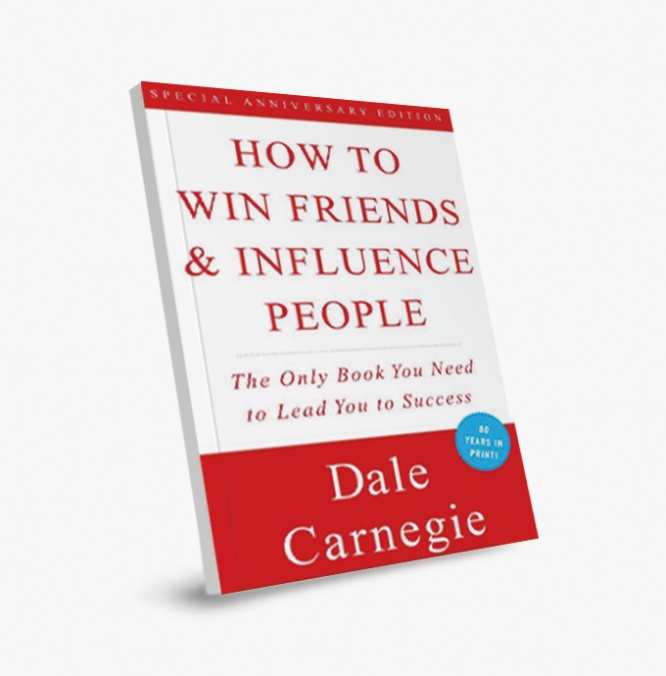
from Dale Carnegie
"How to Win Friends and Influence People" by Dale Carnegie is one of the most influential and timeless books on interpersonal skills, leadership, and effective communication. First published in 1936, its enduring relevance demonstrates a profound truth: no matter how much technology, markets, or business models change, professional success continues to depend largely on the quality of our human relationships. Carnegie starts from a simple but powerful idea: the ability to understand others, show genuine appreciation, and communicate with empathy is a key strategic advantage in any organizational context.
The book offers a practical framework for positively influencing people without manipulation or coercion, based on respect, active listening, and genuine interest in others. For entrepreneurs, intrapreneurs, and business leaders, this work is an essential guide for building trust, aligning wills, and leading teams in increasingly complex and collaborative environments.
"You can make more friends in two months by becoming interested in other people than you can in two years by trying to get other people interested in you." — Dale Carnegie, How to Win Friends and Influence People
The book is structured around clear and actionable principles that Carnegie developed from decades of observation, training, and work with leaders, salespeople, and professionals of all kinds. His approach is not theoretical or academic, but deeply practical, based on real examples and everyday situations.
One of the central pillars of the book is active empathy: the ability to understand the other person's point of view and demonstrate genuine interest in their motivations, concerns, and aspirations. Carnegie maintains that people don't respond to cold logic, but to how they feel treated. Listening attentively, validating emotions, and recognizing the value of others are fundamental skills for positive influence.
Another key principle is the importance of sincere recognition. Carnegie clearly differentiates between genuine praise and superficial flattery. Honestly recognizing people's contributions and achievements strengthens motivation, loyalty, and commitment, while direct criticism and humiliation generate resistance and resentment. The book proposes correcting without attacking, persuading without imposing, and leading without resorting to fear.
Carnegie also emphasizes the power of avoiding unnecessary arguments and seeking agreements based on shared interests. Instead of trying to "win" an argument, he proposes building understanding and cooperation. This approach is especially relevant in organizational environments where teamwork and interdisciplinary collaboration are essential.
Although written in another era, the book adapts surprisingly well to the digital age. In contexts where communication occurs through emails, messages, and video calls, Carnegie's principles remain valid: clarity, respect, listening, and consideration. Technology doesn't replace the human dimension; it amplifies it, for better or worse.
Overall, How to Win Friends and Influence People functions as a practical manual for improving the quality of professional relationships, leading with positive influence, and building lasting networks of trust.
I recommend this book because it's a classic, and still today one of the clearest works for understanding the role of relationships in achievement.
Business is, in essence, a system of human relationships. We can have the best strategy, the best product, or the best technology, but if we don't know how to communicate, listen, and generate trust, the impact will be limited.
From my experience, many organizational conflicts don't originate from technical problems, but from communication failures, poorly managed egos, or lack of empathy. Dale Carnegie offers a simple but profoundly transformative framework for addressing these challenges consciously and effectively.
In the context of Scalabl®, this book is especially relevant because it reinforces a stakeholder-centric view: understanding what moves people, what they value, and how they feel heard is key to building solid value networks. Leading is not imposing, but aligning wills around shared objectives.
I also value that Carnegie doesn't propose manipulation techniques, but rather a relationship ethic based on respect and genuine interest. In an increasingly fast-paced and automated world, this perspective is more necessary than ever.
In summary, How to Win Friends and Influence People is foundational reading for those seeking to grow professionally without losing their humanity, lead with positive influence, and build relationships that sustain long-term success.
"Influence: The Psychology of Persuasion" — Robert B. Cialdini
Delves into the psychological principles that influence decision-making, complementing Carnegie with a scientific look at persuasion and ethical influence.
"The 7 Habits of Highly Effective People" — Stephen R. Covey
Explores personal and interpersonal leadership from a principle-based perspective, reinforcing the importance of character and trust in professional relationships.
"Primal Leadership" — Daniel Goleman, Richard Boyatzis, and Annie McKee
Provides a contemporary look at emotional intelligence and leadership, aligned with the idea that emotions and relationships are central to organizational performance.