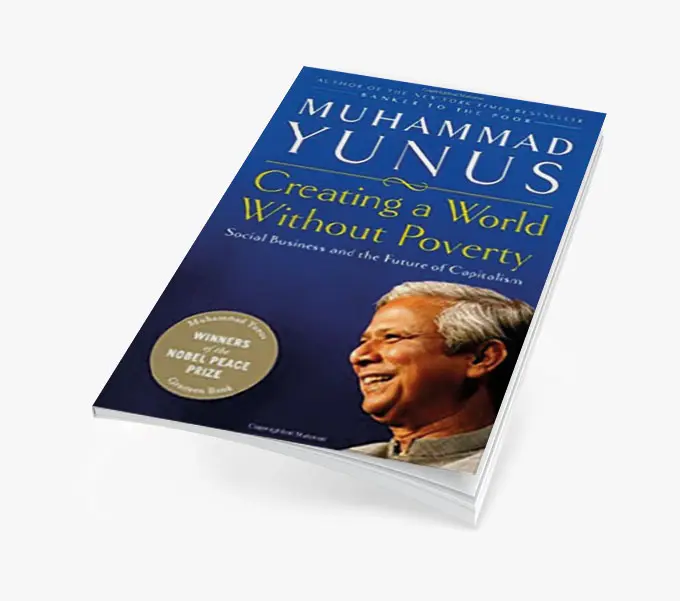
Discover how Muhammad Yunus, Nobel Peace Prize laureate, proposes a new model of capitalism based on social business, where the goal is not to maximize profits but to solve humanity’s most pressing problems, starting with poverty.
“A social business is a company created to solve a social problem. It does not generate dividends for its investors but reinvests all its profits to expand its impact.” — Muhammad Yunus
BOOK SUMMARY
Muhammad Yunus, founder of Grameen Bank and pioneer of microcredit, presents a revolutionary vision in this book: social business. Unlike traditional companies that seek to maximize economic returns for shareholders, a social business is specifically designed to solve a social problem —poverty, malnutrition, lack of access to healthcare or education— and reinvests all its profits to expand that impact. Yunus demonstrates that this idea is not utopia: it already works in Bangladesh and in other countries around the world.
The book traces the history of Grameen Bank, which started by lending 27 dollars to 42 people and ended up transforming the lives of millions of families. Yunus explains how microcredit proved that the poor are reliable credit subjects and that the traditional financial system had simply ignored them. From that experience, he proposes that capitalism can and should be expanded to include companies whose sole purpose is social impact, thus creating a world where poverty is a thing of the past.
Yunus also addresses partnerships with major corporations —such as Danone and BASF— to create social businesses at scale, demonstrating that this model can operate within the global economic system without depending on charity or permanent subsidies.
Yunus opened an entirely new paradigm: business as a tool for social impact. Before him, the conversation about poverty was dominated by humanitarian aid and government programs. Yunus demonstrated that an entrepreneur can design a sustainable business model whose primary purpose is to solve a social problem, not generate dividends. That idea changed the way many of us think about entrepreneurship.
The concept of social business has directly influenced how we think about entrepreneurship at Scalabl®. Not every business needs to maximize profits; some can maximize impact while remaining sustainable. This book is essential for any entrepreneur who wants to understand that there is a broad spectrum between a purely profit-driven company and a nonprofit organization, and that within that spectrum there is room for powerful, transformative business models.
What impacts me most about Yunus is his ability to move from theory to action. He did not stop at criticizing the system; he built an alternative that works and has been replicated in dozens of countries. That pragmatic spirit is what separates true agents of change from those who only talk about changing the world.
Reading is the beginning. Applying is the leap.
At Scalabl you don't stop at the summary: you take the best business ideas to your own venture. Our flagship Entrepreneurship & Innovation Course: 10 years running, graduates in 50+ countries, 12 modules at your own pace.