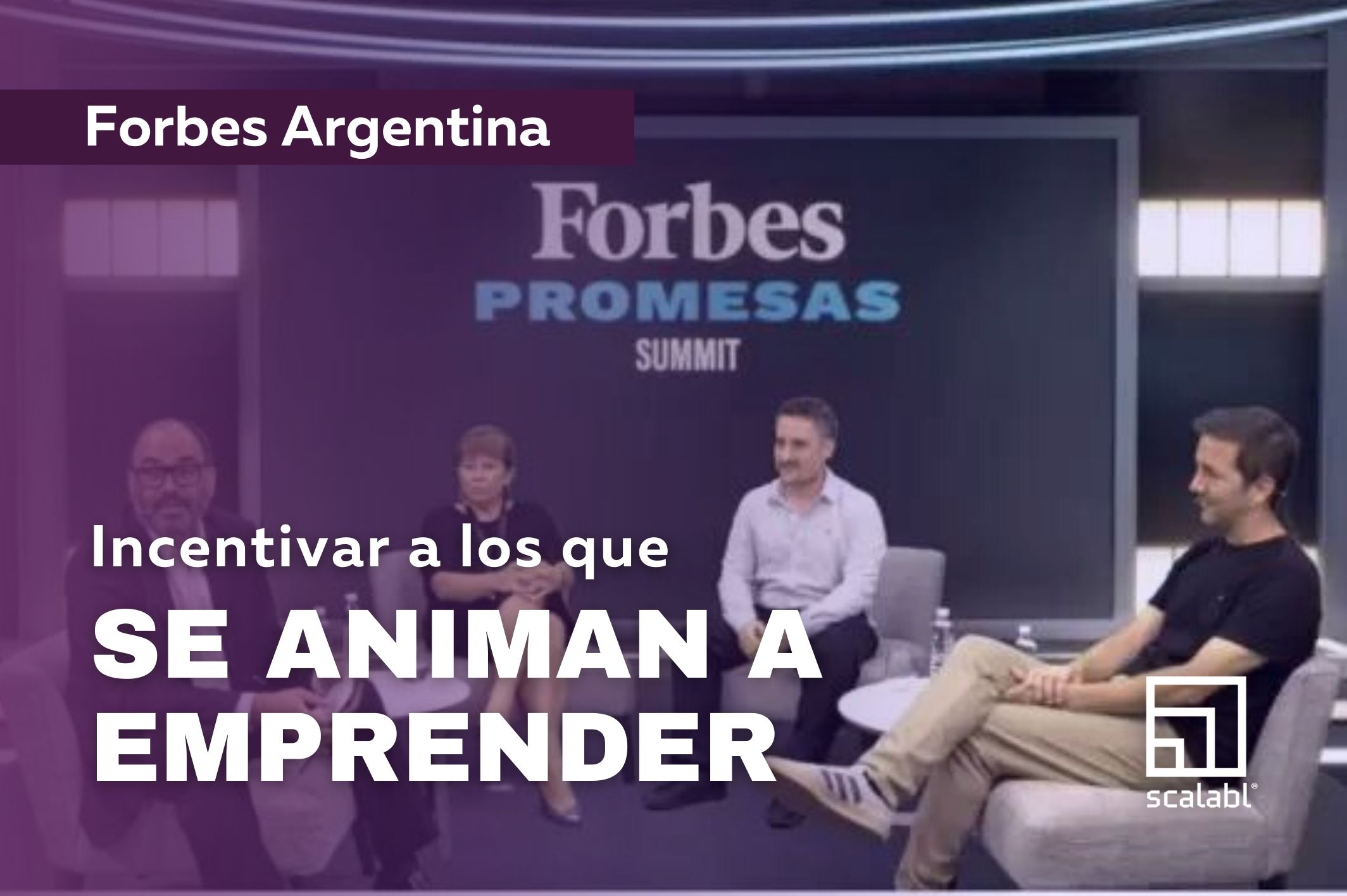
Francisco Santolo proposes a business model that challenges traditional logic: scaling without large initial investments, leveraging democratized technology and a global community of over 2000 graduates across 50 countries. Recognized by Forbes as a reference in innovation, Santolo built a methodology that enables entrepreneurs from anywhere in the world to design scalable business models without depending on initial capital or traditional corporate structures. El Observador from Uruguay explores how Scalabl became a global network where networking and peer collaboration are the true fuel for growth.
The business world is undergoing a profound transformation. The traditional model, based on large initial investments, rigid structures and linear production processes, is giving way to a new logic where democratized technology allows anyone with an idea to turn it into a scalable business. In this context, Scalabl emerges as a paradigm that challenges the conventional rules of the game.
Francisco Santolo, founder of Scalabl, is an Argentine entrepreneur who was recognized by Forbes as one of the leading figures in innovation and scalable business models. His trajectory combines academic training at some of the best universities in the world with practical experience that led him to visit over 50 countries building communities of entrepreneurs.
The Scalabl methodology proposes something that seems counterintuitive to many: designing scalable business models without the need for initial investment. This is achieved through a systematic process that identifies market opportunities, validates hypotheses with the lowest possible risk, and builds models that can grow exponentially by leveraging available technology.
The old business model was based on industrial production logic: manufacture, store, distribute, sell. This chain required capital, infrastructure and time. Today, technology has democratized access to tools that were previously only available to large corporations. Digital platforms, artificial intelligence, automation and global networks allow an entrepreneur to operate from anywhere in the world with minimal costs.
Santolo insists that the key to success is not in having the best idea, but in knowing how to listen. His philosophy is based on the humility of understanding that the market is always right and that the entrepreneur must constantly adapt. Listen to the customer, listen to the market, listen to the data. This stance, far from being passive, requires rigorous discipline and a permanent openness to learning.
The Scalabl community has grown to over 2000 graduates distributed across more than 50 countries. From Latin America to Europe, through Asia and Africa, entrepreneurs from very diverse backgrounds have found in this methodology a concrete path to transform their ideas into real and scalable businesses.
What distinguishes Scalabl from other business training programs is its emphasis on networking as the fuel for growth. The community is not a complement to the program: it is its core. Graduates connect with each other, generate alliances, share learnings and support each other in an ecosystem that enhances individual opportunities.
The Scalabl model also challenges the notion that entrepreneurship is a solitary and high-risk activity. Through its methodology, Santolo demonstrates that it is possible to drastically reduce risk through early validation, rapid iteration and the construction of solid support networks. The entrepreneur is not alone: they are connected with a global community that shares their vision.
Santolo's vision goes beyond training individual entrepreneurs. His goal is to build a global ecosystem where innovation and scalability are accessible to everyone, regardless of their geographic origin, previous training or available capital. It is a democratization of entrepreneurship in its deepest sense.
The El Observador article concludes that Scalabl represents a real paradigm shift in the way of thinking and doing business. It is not just a methodology or an educational program: it is a global movement that is redefining the rules of entrepreneurship in the 21st century.