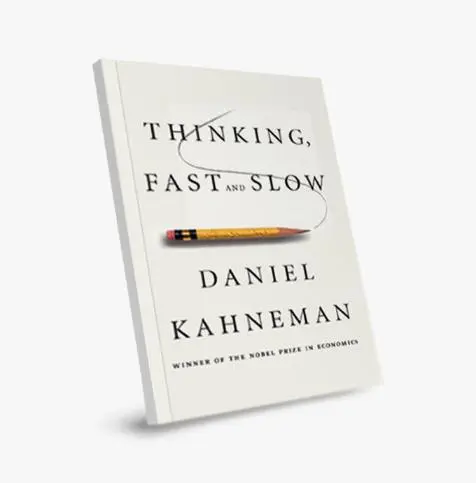
Daniel Kahneman, Nobel Prize laureate in Economics and father of behavioral economics, reveals in this masterwork how the human mind actually works when making decisions. Based on decades of cognitive psychology research, "Thinking, Fast and Slow" demonstrates that we have two thinking systems in constant tension: one fast and intuitive, the other slow and deliberate. This book has transformed entire fields from medicine to finance, from public policy to marketing, revealing the systematic biases that distort our judgment. For entrepreneurs, investors, and leaders, understanding these mechanisms is the difference between making decisions based on reality or on cognitive illusions.
"Nothing in life is as important as you think it is while you are thinking about it." Daniel Kahneman
BOOK SUMMARY
Kahneman organizes the book around the interaction between two mental systems that govern all our thinking:
System 1 and System 2
System 1 operates automatically, without conscious effort. It recognizes faces, completes sentences, and generates instant intuitions. System 2 requires deliberate attention: solving complex calculations, comparing options, or controlling impulses. The fundamental problem is that System 1 dominates most of our decisions, and it's full of shortcuts that produce predictable errors.
Heuristics and Cognitive Biases
Kahneman identifies the mental shortcuts (heuristics) that System 1 uses and the systematic errors (biases) they produce:
• Anchoring: the first number we hear distorts all subsequent estimates. An arbitrary initial price "anchors" the entire negotiation.
• Availability: we judge event probability by how easily we recall examples. Terrorist attacks seem more likely than heart disease because they're more memorable.
• Representativeness: we classify by similarity rather than probability. If someone "looks like an entrepreneur," we ignore actual base rates of success.
• Loss aversion: losing $100 hurts roughly twice as much as gaining $100 feels good. This distorts virtually every financial decision.
Prospect Theory
The contribution for which Kahneman received the Nobel Prize. It demonstrates that people don't evaluate outcomes in absolute terms but relative to a reference point. We don't calculate "how much will I have?" but "how much will I gain or lose compared to where I am?" This explains why we take irrational risks to avoid losses.
The Two Selves: Experiencing vs. Remembering
Kahneman distinguishes between the experiencing self (what we feel moment to moment) and the remembering self (the story we construct afterward). The remembering self dominates our decisions, but it's biased: it overvalues peak moments and endings while ignoring total duration.
Overconfidence and the Illusion of Understanding
One of the most dangerous biases for entrepreneurs: we systematically overestimate our ability to predict the future and underestimate the role of chance. Kahneman demonstrates that experts are no better than chance in most long-term predictions.
This is one of the most important books I've ever read. Not because it's easy to read (it isn't), but because it permanently changes how you think about how you think. Once you understand cognitive biases, you start detecting them everywhere: in your investment decisions, in your negotiations, in how you evaluate opportunities.
For entrepreneurs, the chapter on overconfidence is fundamental. Most business plans are built on optimistic estimates that ignore actual base rates. At Scalabl, we use this concept to force entrepreneurs to seek real market data before projecting growth.
Loss aversion explains why so many entrepreneurs cling to projects that aren't working: the pain of "losing" what's been invested outweighs any rational analysis. Understanding this bias gives you permission to pivot or shut down without guilt.
It's a dense book, but you don't need to read it straight through. Each chapter is an independent insight. My advice: read it slowly, one chapter per week, and note where you recognize these biases in your own recent decisions.
Reading is the beginning. Applying is the leap.
At Scalabl you don't stop at the summary: you take the best business ideas to your own venture. Our flagship Entrepreneurship & Innovation Course: 10 years running, graduates in 50+ countries, 12 modules at your own pace.