
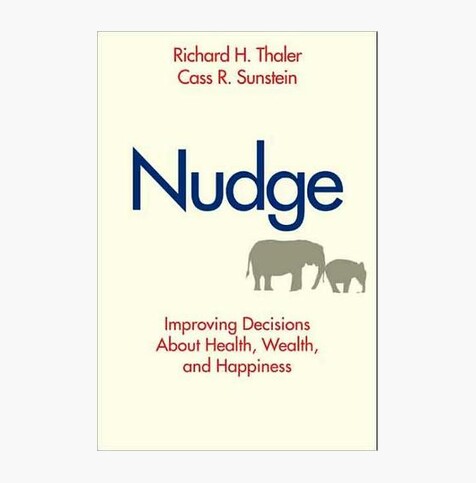
from Richard H. Thaler & Cass R. Sunstein
"Nudge" by Richard H. Thaler and Cass R. Sunstein, published in 2008, is a revolutionary work that introduced the business and academic world to the concept of the "nudge" as a tool for influencing human behavior ethically and effectively. This book became an international phenomenon by demonstrating how small changes in how options are presented can have monumental impacts on the decisions people make. Thaler and Sunstein, pioneers in behavioral economics, combine scientific rigor with practical applications to show how to design "choice architectures" that help people make better decisions about their health, finances, and overall well-being. For entrepreneurs, product designers, marketing leaders, and policymakers, this book offers a powerful framework for understanding predictable human irrationality and leveraging it to create products, services, and systems that genuinely improve people's lives.
BOOK SUMMARY
Key Concepts:
1. The Nudge: Any aspect of the choice architecture that alters people's behavior in a predictable way without forbidding options or significantly changing their economic incentives.
2. Libertarian Paternalism: A philosophy that seeks to influence people's choices in ways that make them better off by their own standards, while preserving their freedom of choice.
3. Common Cognitive Biases:
- Loss Aversion: We feel losses more intensely than equivalent gains
- Status Quo: Tendency to maintain the current situation by default
- Anchoring: Over-relying on the first piece of information received
- Availability: Judging probabilities based on easily recalled examples
4. Choice Architecture: The context in which people make decisions, including default options, presentation of alternatives, and feedback.
5. Practical Applications: From retirement savings to organ donation, the book shows how nudges can solve complex social problems.
WHY I RECOMMEND READING THIS BOOK? By Francisco Santolo
> "Nudge completely changed my way of thinking about product design and user experiences. As an entrepreneur, I spent years believing that people made rational decisions based on complete information. This book showed me that we are creatures of habits, biases, and contexts.
>
> What I value most about Thaler and Sunstein is that they don't stop at theory. They give you concrete principles you can apply immediately. For example: did you know that simply changing the default option from 'opt-out' to 'opt-in' in retirement plans can increase enrollment from 50% to 90%? That's design power.
>
> At Scalabl we apply these principles constantly. When designing our acceleration programs, we ask: How do we make the right action also the easiest one? What default options do we set so entrepreneurs succeed?
>
> This book is especially relevant if you're building digital products, designing sales processes, or creating any system where people need to make decisions. You'll learn to see the world as a 'choice architect' and discover improvement opportunities everywhere."
RELATED BOOKS
| Book | Author | Why Read It |
|------|--------|-------------|
| Thinking, Fast and Slow | Daniel Kahneman | The masterpiece by the father of behavioral economics that delves into the two systems of human thinking. |
| Predictably Irrational | Dan Ariely | An accessible and entertaining tour through the many ways we are predictably irrational. |
| The Paradox of Choice | Barry Schwartz | Explores why more options often lead to less satisfaction and how simplification improves decision-making. |