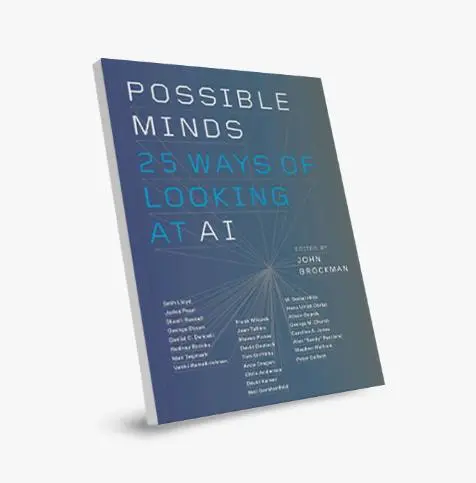
Possible Minds, edited by John Brockman, brings together 25 essays from some of the most influential thinkers of our time to explore the implications of artificial intelligence for humanity. From scientists and philosophers to entrepreneurs and artists, the book offers a mosaic of perspectives that transcends the technical debate and delves into the ethical, social, and existential dimensions of AI. It is an essential work for those seeking to understand not just what artificial intelligence can do, but what it means for our species.
“The question is not whether machines will think, but what it will mean to think when machines do.” — John Brockman
BOOK SUMMARY
Possible Minds takes Norbert Wiener’s original essay on cybernetics as its starting point and uses it as a springboard for 25 contemporary authors to reflect on the future of artificial intelligence. The book does not seek consensus: it deliberately confronts optimistic visions with cautious warnings. Steven Pinker argues that fears of an uncontrolled superintelligence are overblown, while other contributors like Stuart Russell explore the genuine risks of systems that optimize objectives without understanding human values. Daniel Dennett analyzes the philosophical implications of artificial consciousness, and Max Tegmark examines long-term scenarios about the coexistence between humans and intelligent machines.
What sets this anthology apart from other books on AI is the diversity of disciplines represented. It is not just computer scientists talking about algorithms: there are cognitive psychologists, physicists, economists, and cultural theorists contributing their own frames of reference. George Dyson offers a historical perspective on how machines have co-evolved with humans since the origins of computing. Judea Pearl addresses causality and why current machine learning systems still do not understand cause-and-effect relationships. Each essay contributes a different piece of the puzzle, and together they compose a picture far richer than any single viewpoint could provide.
Brockman, founder of Edge.org, has built his career bringing great thinkers together to discuss the most important questions of our time. In Possible Minds, he applies that same approach to AI, achieving a result that is neither utopian nor dystopian, but genuinely complex. The book does not offer definitive answers, but it asks the right questions: who controls the systems that control us? What happens when we delegate critical decisions to algorithms? How do we preserve human agency in an increasingly automated world?
This book is valuable precisely because it does not offer a single narrative about artificial intelligence. We live in an era where the AI debate tends to polarize between naive techno-optimism and paralyzing catastrophism. Possible Minds forces readers to inhabit complexity: to simultaneously consider the extraordinary opportunities and the real risks. For any business leader, entrepreneur, or professional who needs to make strategic decisions in a world transformed by AI, this multiplicity of perspectives is invaluable. You cannot navigate the AI revolution with a single compass.
At Scalabl®, we observe how artificial intelligence is redefining entire industries, business models, and value chains. The entrepreneurs we work with need to understand not just the technical capabilities of AI, but its second and third-order implications: how it changes consumer expectations, how it alters competitive dynamics, how it transforms the very meaning of work. This book provides exactly that kind of systems thinking. It is not a technical manual or an implementation guide, but a tool for expanding one’s capacity to think about what lies ahead.
I recommend Possible Minds especially to those who feel they already understand AI. The people most vulnerable to blind spots are those who believe they have none. This book guarantees that, regardless of the reader’s starting position, at least two or three essays will challenge their assumptions. That intellectual discomfort is exactly what is needed to make better decisions in a territory as uncertain as artificial intelligence.
Reading is the beginning. Applying is the leap.
At Scalabl you don't stop at the summary: you take the best business ideas to your own venture. Want AI in your company's operation and strategy? We identify the problem, design the strategy and build the solution — real software with AI — integrated with your team, week by week.