Discover how Satya Nadella transformed Microsoft from the inside out, replacing a “know-it-all” culture with a growth mindset, and how empathy became the engine of one of the greatest corporate reinventions in history.
“Our company culture needed to shift from a know-it-all to a learn-it-all mindset. A growth mindset demands that each of us continuously reinvent ourselves.” — Satya Nadella
BOOK SUMMARY
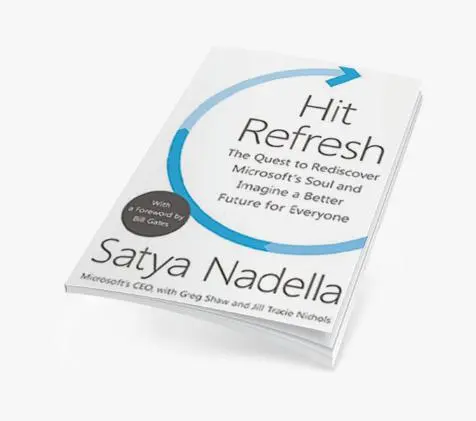
Satya Nadella took over as CEO of Microsoft in 2014, when the company was seen as a stagnant giant, trapped in internal wars and the obsessive defense of Windows. In “Hit Refresh,” Nadella recounts how he led a profound transformation that did not begin with strategy but with culture. His first decision was to redefine the soul of Microsoft: moving from a fixed mindset —where each person’s value depended on what they already knew— to a growth mindset, where value lies in the ability to learn.
The book weaves together three narrative threads: Nadella’s personal story —his childhood in India, the experience of raising a son with cerebral palsy, and how that forged his empathy—, the cultural transformation of Microsoft, and his vision for the future of technology, particularly artificial intelligence, cloud computing, and mixed reality. Nadella argues that empathy is not a “soft” quality but the most critical competency for innovation, because only by deeply understanding others’ needs can you create products that truly matter.
Under his leadership, Microsoft embraced open source, pivoted to the cloud with Azure, acquired LinkedIn and GitHub, and regained its position as one of the most valuable companies in the world. All of that started with a cultural shift that Nadella describes with honesty and depth.
Nadella’s transformation of Microsoft is one of the most remarkable turnarounds in corporate history. What strikes me most is that the transformation was cultural, not just strategic. He replaced the know-it-all culture with a learn-it-all culture. That distinction, which seems subtle, changed everything: the way decisions were made, how teams collaborated, and what kind of innovation was possible.
At Scalabl®, we work with many organizations that need to reinvent themselves, and the most important lesson from this book is that no technological or strategic transformation works if it is not accompanied by a cultural transformation. Nadella did not change the strategy first; he changed the organization’s mindset first, and the strategy was a consequence of that.
This is essential reading for any leader managing organizational change. It is not just about Microsoft; it is about understanding that empathy, humility, and curiosity are the true levers of transformation.
Reading is the beginning. Applying is the leap.
At Scalabl you don't stop at the summary: you take the best business ideas to your own venture. Our flagship Entrepreneurship & Innovation Course: 10 years running, graduates in 50+ countries, 12 modules at your own pace.