
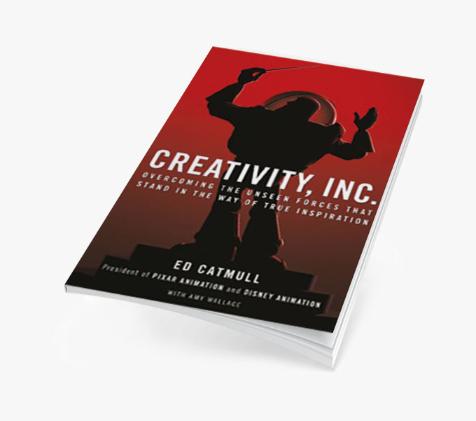
from Ed Catmull
Summary and Why Read the Book
Creativity, Inc. by Ed Catmull — co-founder and President of Pixar Animation Studios — is an essential read for entrepreneurs, leaders and teams aiming to master organizational creativity, sustain innovation over time and build high-performance cultures. The book reveals how Pixar turned early, imperfect and fragile ideas into global successes through well-designed processes, honest feedback, conscious leadership, and a culture that protects and amplifies creativity at every stage. With a practical approach combining management, psychology, storytelling and innovation, Catmull shows that creativity is not a mysterious talent but a system that can be designed, nurtured and scaled. It’s a must read for any organization that aspires to innovate consistently in dynamic markets.
“Early on, all our movies suck. The people are talented, but the ideas are rough and fragile.” —Ed Catmull
Creativity, Inc. recounts Pixar’s evolution from its early days — when the company was fighting for survival — to becoming one of the most influential creative studios in the world. Ed Catmull explains how the company managed to sustain an exceptional level of innovation and quality for decades, by deliberately creating a culture where ideas can be born incomplete, be questioned honestly, and evolve collectively until they reach their full potential.
One of the central concepts of the book is the Braintrust, a review mechanism that brings together directors and creatives to give direct, respectful feedback free of hierarchies. This practice allows projects to improve without fear or defensiveness, creating a constant learning cycle. Catmull also emphasizes the importance of accepting error as part of the creative process, understanding that experimentation and controlled failure are essential drivers of innovation.
The book delves into the role of leadership in creative environments. For Catmull, leaders must remove barriers, promote autonomy, encourage diversity of perspectives, and spot early signs of bureaucracy or rigidity that could stifle creativity. Pixar managed to preserve its culture even amid rapid growth, mergers, technological changes, and consecutive successes — thanks to practices designed to protect openness, humility, and continuous learning.
Finally, Catmull underscores that sustained organizational creativity is a systemic exercise: processes, people, leadership, and culture must interact coherently to allow innovation to flow. Creativity isn’t a privilege for a few — it’s a shared potential that emerges when organizations create the right conditions for everyone to contribute value.
I recommend Creativity, Inc. because it's one of the best books ever written on the delicate art of leading people and organizations in contexts of uncertainty, innovation and growth. Unlike many works focused on superficial techniques or quick formulas, Catmull gives an honest, deep and human look at what truly drives collective creativity: trust, vulnerability, openness and cultural discipline.
In my journey supporting entrepreneurs and teams around the world, I’ve seen creativity get blocked when fear dominates, when hierarchy prevents questioning ideas, or when processes try to control too much. This book proposes the exact opposite: leadership that serves the team, structures that protect early ideas, and feedback mechanisms that strengthen talent rather than limit it.
What I value most is the humility with which Pixar acknowledges that no idea is born brilliant. The organization understands the process matters more than individual brilliance. The real competitive difference emerges from teams that iterate with honesty, listen authentically and dare to fail fast to learn even faster. This philosophy is deeply aligned with the Scalabl® Methodology — environments that are collaborative, interdisciplinary, and based on continuous learning.
Creativity, Inc. invites us to rethink how we build culture, how we design organizations that inspire, how we lead without controlling, and how we unleash the natural creativity within people. It’s a transformative book for anyone who wants to lead the future with consciousness, empathy and real capacity for innovation.
“The Ride of a Lifetime” — Robert Iger
A remarkable look at leadership and cultural transformation at Disney. Complements Creativity, Inc. with lessons on strategic decisions, creative diversity, change management, and Disney’s historical relationship with Pixar.
“Work Rules!” — Laszlo Bock
Explores how Google built a culture rooted in autonomy, purpose and transparency. A great read to deepen understanding of modern talent management, agile structures and organizational creativity.
“Originals” — Adam Grant
A fascinating analysis of how to identify, encourage and scale original ideas within organizations and teams. It expands Catmull’s focus by diving into psychology, risk-taking and organizational behavior that favors innovation.