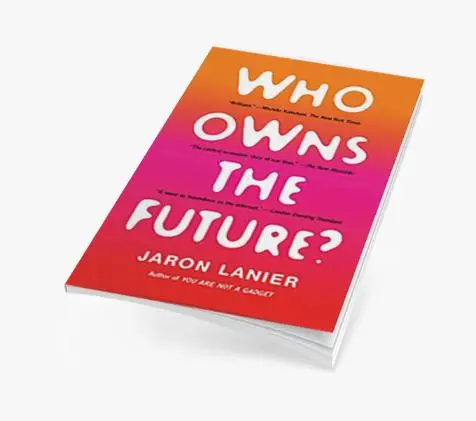
Who Owns the Future? by Jaron Lanier is a deep and provocative critique of the internet’s economic model. Lanier, a pioneer of virtual reality and one of Silicon Valley’s most original technologists, argues that the current digital economy is destroying the middle class by concentrating wealth among those who control the large data servers —what he calls “siren servers”— while the millions of people who generate that data receive no compensation. It is a book that questions the foundations of the technological model we take for granted.
“If something is free on the internet, then the product is you. And when the product is you, your economic future is at risk.” — Jaron Lanier
BOOK SUMMARY
Lanier starts from an uncomfortable observation: the digital economy, as currently designed, destroys more jobs and economic value than it creates for most people.
Siren servers: The most powerful companies in the digital world (Google, Facebook, Amazon) are essentially machines for collecting data that others produce. These companies capture enormous value from information that millions of users generate for free —searches, posts, purchases, preferences— and monetize it without sharing the profits.
The destruction of the middle class: Lanier shows how entire industries (music, photography, journalism, translation) have been hollowed of economic value by platforms that offer “for free” what previously sustained millions of jobs. The result is an economy with few enormous winners and many silent losers.
The proposal: universal micropayments: Lanier does not merely criticize: he proposes a radical solution. Every time data generated by a person is used (by an algorithm, a search engine, an AI system), that person should receive a micropayment. This would create an information economy where data has ownership and value, restoring the digital middle class.
Technological humanism: Lanier advocates for an approach to technology that puts people at the center. He is not anti-technology: he is anti-dehumanization. He believes technology can and should serve to amplify human dignity, not diminish it.
The book is dense, polemical, and sometimes hard to follow, but its central ideas are more relevant today than when published. With the explosion of generative artificial intelligence, the question of who owns the data and who benefits from it is more urgent than ever.
Lanier is a unique voice in the tech world: an insider who questions the fundamental premises of the industry he helped create. This book forced me to think critically about the internet’s “everything free” model and its consequences for content creators, independent professionals, and the middle class in general.
What impacted me most is his argument about how free-ness destroys economic value for the majority while concentrating wealth among the few. In the entrepreneurial ecosystem this is especially relevant: many startups adopt the “freemium” model without questioning its long-term implications for ecosystem sustainability.
I also find his micropayments proposal visionary. With the arrival of generative artificial intelligence —which trains on data created by people— Lanier’s question becomes urgent: who compensates the creators whose data feeds these systems? It is a debate that is just beginning, and Lanier anticipated it years ago.
It is a book that makes you uncomfortable, and that is precisely what makes it valuable. It does not offer easy solutions, but it plants seeds of critical thinking that every technology entrepreneur should consider.
Reading is the beginning. Applying is the leap.
At Scalabl you don't stop at the summary: you take the best business ideas to your own venture. Want AI in your company's operation and strategy? We identify the problem, design the strategy and build the solution — real software with AI — integrated with your team, week by week.