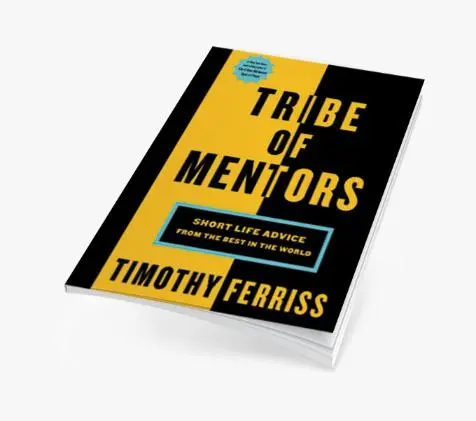
Tribe of Mentors by Tim Ferriss is a massive compilation of practical wisdom extracted from more than 130 of the world’s most successful people. Ferriss asked them all the same 11 questions —from “What is your favorite failure?” to “What book do you gift the most?”— and the result is a fascinating mosaic of perspectives, habits, routines, and life philosophies from entrepreneurs, athletes, writers, investors, and artists. It is not a book to read from start to finish: it is a book to explore, bookmark, and return to again and again.
“Life shrinks or expands in proportion to one’s courage.” — Anaïs Nin, quoted by Tim Ferriss
BOOK SUMMARY
Ferriss created this book during a personally difficult moment and built it as an exercise in seeking answers through those he most admires. The 11 standard questions include:
What book do you gift the most? The answers reveal patterns: books like Marcus Aurelius’s Meditations, Harari’s Sapiens, and Frankl’s Man’s Search for Meaning appear repeatedly. This is no coincidence: the most effective people tend to read about stoicism, history, and meaning, not just business.
What is your favorite failure? The failure stories are the book’s most valuable content. Investors who lost everything, entrepreneurs who were fired, artists who were rejected hundreds of times. The pattern is clear: failure is not an obstacle to success but a prerequisite.
What would you put on a giant billboard? Answers range from the philosophical (“Don’t believe everything you think”) to the practical (“Automate your finances”). These are sentences that condense decades of experience into a single line.
Routines and habits: Meditation, morning exercise, journaling, and reading appear with overwhelming frequency. This is not coincidence: there is a clear pattern in how high-performance individuals structure their days to protect their energy, creativity, and mental clarity.
Advice to their 20-year-old self: Perhaps the most revealing question. Patterns include: “don’t be in such a rush,” “invest in relationships, not things,” “say no much more often,” and “most of what you worry about will never happen.”
The book includes profiles of people as diverse as Ray Dalio (investor), Brené Brown (researcher), Steven Pressfield (writer), Ashton Kutcher (actor and investor), and dozens more. That diversity is its greatest strength: wisdom emerges from patterns that cross disciplines, not from a single perspective.
Ferriss has a unique talent for extracting the essential from extraordinary people. He is not a conventional interviewer: he is a deconstructionist of habits, routines, and decisions. Tribe of Mentors works like having access to 130 mentoring sessions with people who would normally be unreachable.
What I value most about Ferriss is his honesty and how he shares everything generously, while also opening us to the world of other thinkers. Each profile is a door to new ideas, new books, new ways of seeing life. The reflections on failures, fears, and painful lessons give the book an authenticity that is hard to find in conventional business literature.
I also find the format powerful. You don’t have to read it cover to cover. You can open to any page, read a 5-minute profile, and walk away with an idea that changes your perspective for the day. It is a bedside book in the most literal sense: ideal for reading one entry before sleep or at the start of the morning.
The emerging patterns are revealing. When 130 radically different people agree that meditating, exercising, reading, and saying no are the keys to their performance, that stops being opinion and becomes evidence. Ferriss does not preach: he lets the data speak.
Read it like a tasting menu: try a bit of each profile and go deeper into the ones that resonate. Not all will resonate, and that is fine. What matters is that those that do can change how you think about a specific problem.
Reading is the beginning. Applying is the leap.
At Scalabl you don't stop at the summary: you take the best business ideas to your own venture. Our flagship Entrepreneurship & Innovation Course: 10 years running, graduates in 50+ countries, 12 modules at your own pace.