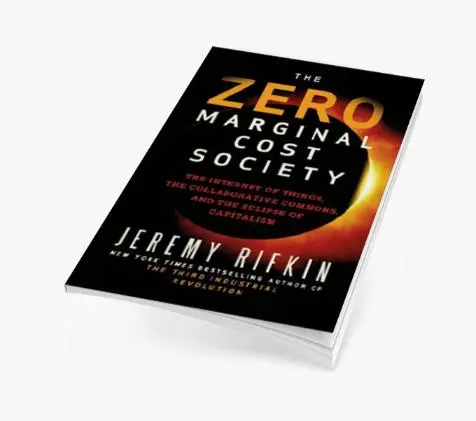
The Zero Marginal Cost Society by Jeremy Rifkin is a bold vision of the global economic future. Rifkin, advisor to European governments and the European Commission, argues that capitalism is becoming a victim of its own success: competition and technology are driving the marginal costs of producing goods and services toward zero, making the traditional market model based on scarcity obsolete. In its place, a collaborative economy emerges, driven by the Internet of Things, renewable energy, and digital fabrication.
“Capitalism is giving birth to an offspring that will replace it: the collaborative commons. It will not disappear overnight, but its dominant role in civilization is coming to an end.” — Jeremy Rifkin
BOOK SUMMARY
Rifkin builds his argument on a fundamental economic observation: when the marginal cost of producing an additional unit approaches zero, the price also tends toward zero, and the business model based on selling copies collapses.
It already happened in information: Music, books, news, and education have already undergone this transformation. Billions of people produce and share information at near-zero marginal cost. Industries that depended on controlling copies —record labels, publishers, media— were the first to feel the impact.
It is happening in energy: Rifkin describes how solar panels and wind energy are driving the marginal cost of electricity toward zero. Millions of homes and businesses become simultaneous producers and consumers (prosumers), connected in smart grids that distribute energy like the internet distributes information.
It will reach manufacturing: 3D printing and digital fabrication promise to do the same with physical objects. When anyone can manufacture customized products from home, global supply chains transform radically.
The collaborative commons: Rifkin proposes that alongside the capitalist market, a third sector emerges —the collaborative commons— where people share instead of owning: housing (Airbnb), transportation (Uber, car sharing), knowledge (Wikipedia, MOOCs), financing (crowdfunding). This sector does not seek profit but access, and its logic is fundamentally different from capitalism.
The book is ambitious in scope, covering economics, technology, energy, education, and social transformation. Rifkin writes with the conviction of someone who believes they are describing a civilizational shift, not just a market trend.
Rifkin does something few economists achieve: connecting technological trends with deep social transformations and doing so accessibly. This book helped me understand why so many traditional business models are collapsing and why the new models emerging are so different in their fundamental logic.
What impacted me most is the idea that zero marginal cost is not an anomaly but the natural direction of technology. If that is true —and the evidence suggests it is— then any business model that depends on artificial scarcity has an expiration date. That fundamentally changes how entrepreneurs must think about their value proposition.
In the Scalabl® context, this book is required reading when we discuss business models with entrepreneurs. It helps them ask: does my model depend on controlling something that will eventually be free? Am I building on real or artificial scarcity? Those questions are uncomfortable but essential.
I don’t agree with all of Rifkin’s predictions —some are too optimistic about adoption timelines— but the conceptual framework is powerful and forces long-term thinking, which is exactly what entrepreneurs need.
Reading is the beginning. Applying is the leap.
At Scalabl you don't stop at the summary: you take the best business ideas to your own venture. Want AI in your company's operation and strategy? We identify the problem, design the strategy and build the solution — real software with AI — integrated with your team, week by week.