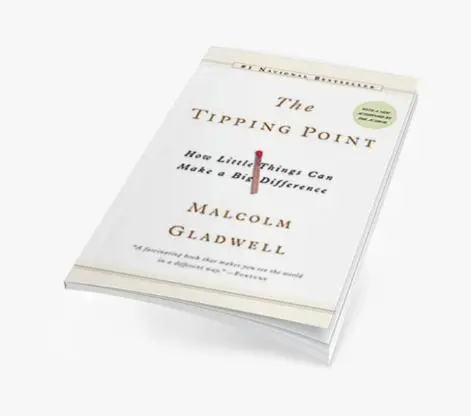
The Tipping Point by Malcolm Gladwell explores the exact moment when an idea, a product, or a behavior crosses an invisible threshold and spreads like an epidemic. Through fascinating stories —from how Hush Puppies went from forgotten shoe to cultural phenomenon, to how New York City dramatically reduced its crime rate— Gladwell identifies the patterns that make some ideas contagious while others die in silence. An essential book for anyone who wants to understand how to generate impact at scale.
“The tipping point is that magic moment when an idea, trend, or social behavior crosses a threshold, tips, and spreads like wildfire.” — Malcolm Gladwell
BOOK SUMMARY
Gladwell structures the book around three laws that explain how social epidemics spread:
The Law of the Few: Not all people have the same impact on the spread of ideas. Gladwell identifies three key types: Connectors (people with extraordinarily wide social networks), Mavens (knowledge accumulators who enjoy sharing information), and Salesmen (people with natural charisma to persuade). These three profiles are the catalysts of every social epidemic.
The Stickiness Factor: For a message to spread, it has to be memorable. Gladwell analyzes cases like Sesame Street and Blue’s Clues to show how small adjustments in how a message is presented can transform its impact. It’s not about shouting louder but about making the message “stick.”
The Power of Context: The environment matters more than we think. Gladwell shows how small changes in context —cleaning graffiti, fixing broken windows— can generate massive changes in human behavior. Our actions are far more conditioned by our environment than by our personality.
The Rule of 150: Human groups function optimally when they don’t exceed 150 people (Dunbar’s number). Beyond that limit, social cohesion weakens and informal norms stop working.
This was one of the first books that made me understand that the success of an idea doesn’t depend only on the quality of the idea, but on how, when, and through whom it is transmitted. That completely changed the way I think about marketing, product launches, and building communities.
What impacted me most was the Law of the Few. In any project I’ve launched, the first 5 or 10 connectors who get hooked make the difference between something that takes off and something that dies. It’s not about reaching millions but about reaching the right people.
The Stickiness Factor is also key for entrepreneurs. Most startups fail not because their product is bad, but because their message doesn’t stick. Gladwell demonstrates that small changes in how you present an idea can be the difference between it going viral or going unnoticed.
Read it if you’re launching something —a product, a movement, an idea— and want to understand why some things explode and others don’t, despite having the same quality.
Reading is the beginning. Applying is the leap.
At Scalabl you don't stop at the summary: you take the best business ideas to your own venture. Our flagship Entrepreneurship & Innovation Course: 10 years running, graduates in 50+ countries, 12 modules at your own pace.