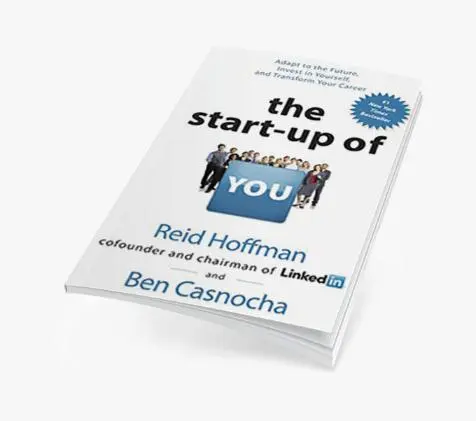
The Start-up of You by Reid Hoffman and Ben Casnocha proposes a radical but inevitable idea: in a world where lifelong employment and linear careers no longer exist, each person must manage themselves as if they were a startup. Hoffman, co-founder of LinkedIn and legendary Silicon Valley investor, translates entrepreneurship principles —adaptability, networks, competitive advantage, pivoting— to the terrain of personal professional development. It is not a self-help book: it is a strategic manual for navigating an economy where the only constant is change.
“All human beings are entrepreneurs. Not because they should all start companies, but because the will to create is encoded in human DNA.” — Reid Hoffman
BOOK SUMMARY
Hoffman and Casnocha organize the book around the principles that make a startup successful, applied to individual professional careers:
Personal competitive advantage: Just as a startup needs a clear differentiator, every professional needs to identify the unique intersection of their assets (skills, experience, knowledge), their aspirations (what they want to do), and market realities (what the world needs and pays for). The advantage is not static: it evolves over time.
Plan ABZ: Hoffman proposes always having three plans. Plan A is the current direction, constantly adjusted. Plan B is the pivot: a change of course based on new learning. And Plan Z is the lifeline: a backup plan that enables risk-taking because there is a safety net.
Smart networks: It is not about accumulating contacts but building genuine alliances. Hoffman distinguishes between strong ties (close allies who invest in your success) and weak ties (diverse acquaintances who provide information and unexpected opportunities). Both are critical, but weak ties tend to be more underestimated.
Smart risk: The best professionals do not avoid risk: they manage it. Hoffman argues that not taking risks is, paradoxically, the riskiest position in an economy that rewards adaptability. The key is taking calculated risks where the potential upside far outweighs the downside.
Permanent beta: Just as a software product is never “finished,” a professional must remain in permanent beta: always learning, always iterating, never assuming they have arrived. Complacency is the silent enemy of successful careers.
The book combines Hoffman’s personal experience as an entrepreneur and investor with research on social networks, labor economics, and cases of professionals who applied these principles to transform their careers.
Hoffman is one of the entrepreneurs I admire most —and as co-founder of LinkedIn, he created what is my favorite social network and platform. This book captures something I see every day in the entrepreneurial ecosystem: the entrepreneurial mindset is not just for those who create companies, it is for anyone who wants to have agency over their professional future. In a world where industries transform in years, not decades, thinking like a startup is not an option but a necessity.
The Plan ABZ is one of the most practical tools I have found for managing professional uncertainty. At Scalabl® we use it constantly with entrepreneurs: having a clear Plan Z —a backup scenario that allows survival if everything fails— frees the ability to take risks with Plan A. Without a safety net, fear paralyzes.
I also greatly value his treatment of networks. Hoffman does not talk about superficial networking or collecting business cards. He talks about building genuine relationships where both parties add value. The idea that weak ties are often more valuable than strong ones for finding opportunities is counterintuitive but backed by decades of sociological research.
It is a book I recommend especially to professionals who feel their career has stagnated or who face an important transition. It does not offer easy answers, but it does provide a clear framework for thinking strategically about the next move.
Reading is the beginning. Applying is the leap.
At Scalabl you don't stop at the summary: you take the best business ideas to your own venture. Our flagship Entrepreneurship & Innovation Course: 10 years running, graduates in 50+ countries, 12 modules at your own pace.