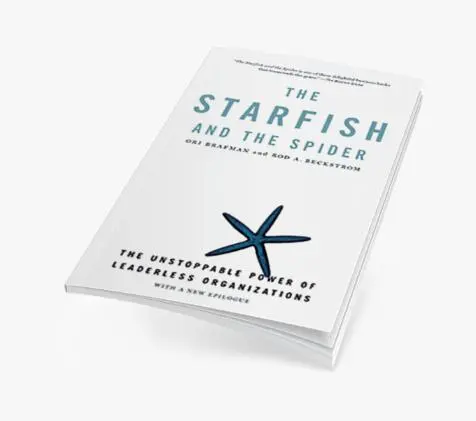
"The Starfish and the Spider: The Unstoppable Power of Leaderless Organizations" by Ori Brafman and Rod Beckstrom is a deep analysis of the difference between centralized (spider) and decentralized (starfish) organizations. Published in 2006, it anticipated phenomena like Wikipedia, Airbnb, Uber, blockchain, and decentralized social movements that have transformed entire industries.
"If you cut off a spider's head, it dies. If you cut off a starfish's arm, not only does it survive, but the cut arm can regenerate a new star. Spider organizations have a head; starfish don't." - Ori Brafman
BOOK SUMMARY
Brafman and Beckstrom contrast two opposing organizational architectures:
The Spider (Centralized):
Spider organizations have clear hierarchical structure, defined chain of command, and concentration of power at the top. Cut the head (CEO, dictator, capital) and the organization collapses. Examples: traditional companies, centralized governments, conventional armies.
The Starfish (Decentralized):
Starfish organizations operate without identifiable center of power. There's no head to cut. Each "arm" is autonomous and intelligence is distributed. Cut one part and the rest continues; even the cut part can regenerate the complete organization.
The five principles of starfish organizations:
1. Circles: Autonomous units connect without a center coordinating them
2. The idea is the leader: A shared ideology provides cohesion, replacing the CEO
3. Pre-existing circles: Starfish organizations emerge from natural social networks
4. Easy to join, hard to control: Low barriers to entry but impossible to co-opt
5. Attack from below: Starfish erode established business models from the base
When a spider must become a starfish:
Brafman documents how entire industries were disrupted when someone applied decentralization principles: music (Napster, iTunes, streaming), taxis (Uber), hospitality (Airbnb), software (open source), activism (leaderless social movements).
This book is prophetic. Published in 2006, it described the architecture of organizations that dominate today: Wikipedia, Uber, Airbnb, blockchain, movements like Occupy or Black Lives Matter. Brafman anticipated that decentralization would be the disruptive force of the 21st century.
I especially recommend it because we're building something between both models. We need spider efficiency (clear processes, consistent deliverables, controlled quality) but starfish adaptability (rapid response to market changes, distributed innovation, resilience). Understanding both models allows us to design intentional hybrids.
If you're building a startup, ask yourself: are you a spider or a starfish? Does your business depend on your presence to function? Can you scale without adding proportional hierarchy? The answers determine your growth limit and resilience to crisis.
Reading is the beginning. Applying is the leap.
At Scalabl you don't stop at the summary: you take the best business ideas to your own venture. Our flagship Entrepreneurship & Innovation Course: 10 years running, graduates in 50+ countries, 12 modules at your own pace.