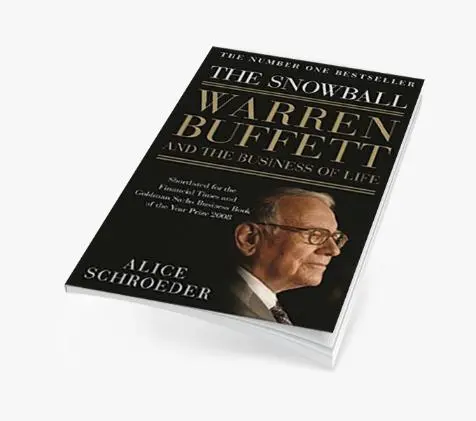
"The Snowball" by Alice Schroeder is a deep, honest, and extraordinarily revealing biography about the life and mind of Warren Buffett, one of the most influential investors and businesspeople in history. More than a chronological account of financial successes, the book explores how a sustainable competitive advantage is built over time through clear principles, extreme discipline, and a long-term vision. The title is no accident: the snowball metaphor summarizes the central idea that runs throughout the entire work—the power of compound interest applied not only to financial capital, but also to knowledge, reputation, and relationships.
Schroeder, who had unprecedented access to Buffett for years, portrays both the brilliant investor and the complex person behind the myth. The book shows how Buffett developed from a very young age an almost unique obsession with understanding how businesses, money, and incentives work, and how that constant curiosity, combined with patience and consistency, led to extraordinary results. For entrepreneurs, leaders, and investors, The Snowball is a masterful lesson on how to think, decide, and act with consistency in uncertain environments.
"The difference between successful people and really successful people is that really successful people say no to almost everything." — Warren Buffett, The Snowball
BOOK SUMMARY
The book traces Warren Buffett's life from his childhood in Omaha, where he already showed an unusual affinity for numbers and business, to his consolidation as leader of Berkshire Hathaway. Schroeder details how Buffett began investing under the strict principles of value investing from his mentor Benjamin Graham, focused on buying undervalued assets with a wide margin of safety. This initial stage laid the foundations of his financial discipline and his structural aversion to unnecessary risk.
Throughout the book, Buffett's evolution in thinking is shown, especially from his relationship with Charlie Munger, who helped him move from a purely quantitative logic to a more qualitative one: buying extraordinary businesses at reasonable prices, instead of mediocre businesses at cheap prices. This conceptual shift was key to Berkshire Hathaway's exponential growth and to building a portfolio based on lasting competitive advantages, good management teams, and understandable business models.
Schroeder also delves into Buffett's mental process: his obsessive focus on the long term, his rejection of market fads, his preference for simplicity, and his ability to say "no" to almost all opportunities. The book makes clear that Buffett's success doesn't come from supernatural intelligence, but from an uncommon combination of patience, consistency, emotional self-control, and clarity of principles.
Another relevant axis is the emphasis on continuous learning. Buffett dedicates much of his time to reading, studying, and thinking. The biography shows how this habit, sustained over decades, allowed him to build a deep understanding of multiple industries and progressively improve his judgment. Knowledge, like capital, compounds.
The book also addresses Buffett's human and ethical dimension: his personal relationships, his contradictions, his austere lifestyle, and his commitment to integrity. In the final stage of his life, his decision to dedicate most of his fortune to philanthropy—influenced in part by Bill Gates—reveals a vision of success that transcends wealth accumulation and focuses on long-term positive impact.
A wonderful book for business lovers and a profound lesson on how to build sustainable advantages over time.
Buffett exemplifies each year how to wait patiently and act with conviction when conditions are right. It's impossible not to feel inspired by his character and his teachings.
Many entrepreneurs and leaders underestimate the value of the long term, discipline, and consistency. This book shows that extraordinary success is rarely explosive; it's usually the result of thousands of well-aligned decisions, made consistently over decades. A key teaching for anyone building a business, a career, or an organization.
Buffett understands businesses as living systems, where reputation, trust, and incentives matter as much as numbers. His emphasis on integrity, surrounding himself with exceptional people, and avoiding unnecessary complexities is deeply applicable to modern organizational design.
I also value that the book doesn't idealize Buffett. It shows his limitations, mistakes, and personal costs, which makes him even more human and credible. That's precisely where his greatest teaching lies: it's not about being perfect, but about being consistent with clear principles.
The Snowball is a powerful example of how the path of purpose is built throughout an entire life. And it allows embracing the virtues of compound growth—financial, intellectual, and human.
The foundational work of value investing and the book that most influenced Warren Buffett. It deepens the concepts of margin of safety, fundamental analysis, and emotional discipline in investing.
"Poor Charlie's Almanack" — Charles T. Munger
A compilation of Charlie Munger's thinking, Buffett's partner. It offers a complementary vision on mental models, decision-making, and interdisciplinary thinking.
"Principles" — Ray Dalio
Explores how to build decision-making systems based on clear principles, continuous learning, and radical transparency, in line with many of the ideas Buffett applies practically.
Reading is the beginning. Applying is the leap.
At Scalabl you don't stop at the summary: you take the best business ideas to your own venture. Our flagship Entrepreneurship & Innovation Course: 10 years running, graduates in 50+ countries, 12 modules at your own pace.