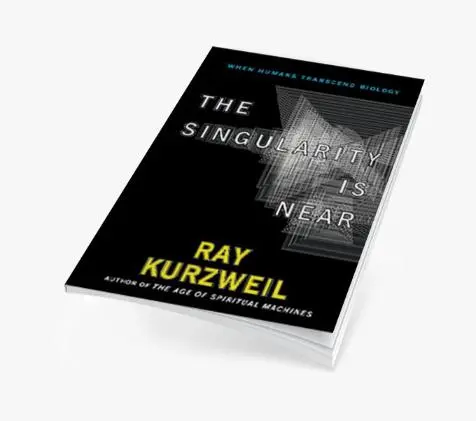
The Singularity Is Near by Ray Kurzweil is the most ambitious work about the future of humanity ever written by a scientist. Kurzweil —inventor, futurist, and director of engineering at Google— argues that technological progress is exponential, not linear, and that we are approaching a point —the singularity— where artificial intelligence will surpass human intelligence and merge with it, radically transforming what it means to be human. This book is essential reading for anyone who wants to understand the forces that will redefine the economy, health, education, and the human condition itself in the coming decades.
“Our future is not the experience of a hundred years of progress in the 21st century; it will be more like twenty thousand years of progress (at today’s rate).” — Ray Kurzweil
BOOK SUMMARY
Kurzweil structures the book around the Law of Accelerating Returns and its implications across six areas of transformation:
The Law of Accelerating Returns: Kurzweil’s central idea. Technological progress is not linear but exponential: each generation of technology builds upon the previous one, accelerating the pace of change. What took decades in the 20th century will take years in the 21st and months in the 22nd.
Genetics (GNR — Genetics): The biological revolution that will allow us to reprogram our biology. Kurzweil anticipates gene therapies that will eliminate diseases, reverse aging, and dramatically extend human life expectancy.
Nanotechnology (GNR — Nano): Molecular-scale robots that will be able to repair cells, clean pollution, manufacture any product atom by atom, and revolutionize medicine from inside the body.
Robotics and AI (GNR — Robotics): Artificial intelligence that will equal and surpass human intelligence. Kurzweil predicts that by the mid-21st century, AI will not only solve problems but will be creative, emotional, and conscious.
Human-machine fusion: The singularity is not the machine replacing the human but merging with it. Brain-computer interfaces, nanobots in the bloodstream, digital cognitive extensions —Kurzweil envisions a future where the line between biology and technology disappears.
Kurzweil backs his predictions with a detailed historical analysis of how technology followed exponential curves for centuries. He shows that our brains are designed to think linearly —to add, not multiply— and that’s why we systematically underestimate the speed of change. The book is not science fiction: it is a documented extrapolation of real trends, written by someone whose previous predictions came true with remarkable accuracy.
This book blew my mind the first time I read it, and it continues to do so every time I revisit it. Kurzweil doesn’t do cheap futurology: he documents every claim with data, graphs, and historical analyses that are difficult to refute. His ability to see patterns where others see chaos is extraordinary.
What impacted me most was the idea that we radically underestimate the speed of change. Our brain thinks in linear progressions (1, 2, 3, 4, 5...) when technological reality advances in exponential progressions (1, 2, 4, 8, 16, 32...). That explains why artificial intelligence went from being an academic curiosity to transforming entire industries in less than a decade.
For entrepreneurs and leaders, this book is fundamental because it forces you to think in longer time horizons and more aggressive change curves. If you’re building a business today, you need to understand that technologies that seem distant —advanced AI, nanotechnology, brain-computer interfaces— will impact your industry much sooner than you imagine.
Not everything Kurzweil predicts will come true on the timelines he proposes —his timeline sometimes errs on the optimistic side— but the general direction of his predictions has proven consistently correct. The key is not whether the singularity arrives in 2045 or 2060, but that the convergence of these technologies will transform everything we know. Preparing for that is the responsibility of any serious leader.
Read it if you want to understand not just where technology is headed, but where the human species is headed. It is one of the most important books of the 21st century.
Reading is the beginning. Applying is the leap.
At Scalabl you don't stop at the summary: you take the best business ideas to your own venture. Want AI in your company's operation and strategy? We identify the problem, design the strategy and build the solution — real software with AI — integrated with your team, week by week.