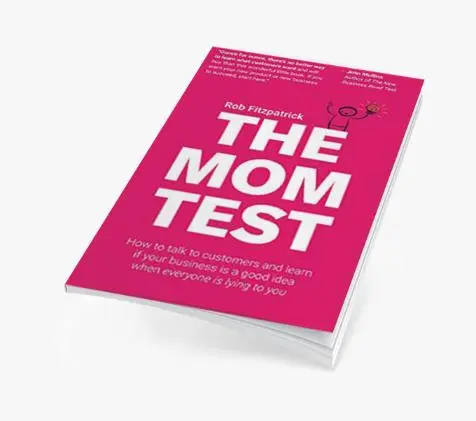
The Mom Test by Rob Fitzpatrick is the most honest and practical book ever written about how to talk to customers. Its premise is devastating: almost all conversations that entrepreneurs have with potential customers are useless, because they are designed to obtain validation rather than truth. Fitzpatrick teaches how to ask questions that not even your mother could answer with a polite lie —hence the name. It is a short, direct, and brutal book that should be required reading before building any product.
“Opinions are worthless. The only things that matter are facts and concrete commitments.” — Rob Fitzpatrick
BOOK SUMMARY
Fitzpatrick starts from a universal problem: when you tell someone your business idea, everyone says it’s great. Friends, family, acquaintances —they all lie out of politeness. And entrepreneurs deceive themselves believing that those positive opinions are market validation.
The three rules of The Mom Test: (1) Talk about their life, not your idea. (2) Ask about specific past behaviors, not hypothetical future opinions. (3) Talk less and listen more. These three rules sound simple but go against everything an enthusiastic entrepreneur naturally wants to do.
Questions that work: Instead of asking “Do you think this idea is good?” (useless), ask “How do you solve this today?” or “How much did you pay the last time you tried to solve it?” What people do with their time and money reveals what truly matters to them, not what they say matters.
Commitments as validation: Fitzpatrick introduces the idea that the only valid signal of interest is a concrete commitment: a deposit, a letter of intent, an introduction to their boss. If the customer is not willing to take a real step, their “I love it” is worthless.
Avoiding common traps: Seeking compliments instead of truths. Asking leading questions. Revealing the idea too early. Confusing a pleasant meeting with a useful meeting. Fitzpatrick disarms each of these traps with concrete and painfully recognizable examples.
The book also covers how to get discovery meetings, how to structure them, how to take useful notes, and how to analyze the information gathered. All in less than 150 pages, with no filler or unnecessary theory.
This book should be the first book anyone reads before starting a venture. Before the business plan, before the MVP, before everything. Because the most expensive mistake in a startup is not building the product badly: it is building the wrong product. And most entrepreneurs build the wrong product because they confuse others’ enthusiasm with real demand.
What I value most about Fitzpatrick is his constructive brutality. He does not seek to motivate: he seeks to prevent you from throwing months of work in the trash for not having asked the right questions at the beginning. In Scalabl®’s methodology, this book is a permanent reference: we use it to practice and deepen the problem interview, one of the central tools of our Customer Development process. Fitzpatrick’s principles allow us to train entrepreneurs to go out and have real conversations with customers and come back with genuine information, not compliments disguised as validation.
The rule of “don’t talk about your idea” at the beginning of interviews is counterintuitive but brilliant. When you start by talking about your idea, the listener enters politeness mode and says what you want to hear. When you start by asking about their real life, truth emerges —and truth is the only solid foundation for building a business.
I also find his concept of “commitments as validation currency” very powerful. I have seen hundreds of entrepreneurs with “positive feedback” from potential customers who then never bought anything. The only validation that matters is the one that hurts: a deposit, a signed commitment, a concrete action.
Read it in an afternoon. It takes 2 hours and can save months —or years— of misguided work.
Reading is the beginning. Applying is the leap.
At Scalabl you don't stop at the summary: you take the best business ideas to your own venture. Our flagship Entrepreneurship & Innovation Course: 10 years running, graduates in 50+ countries, 12 modules at your own pace.