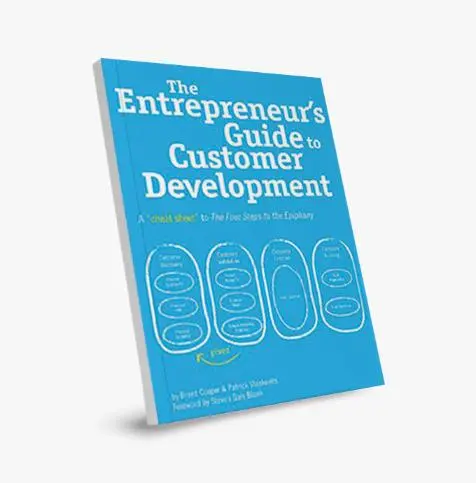
«The Entrepreneur’s Guide to Customer Development» by Brant Cooper and Patrick Vlaskovits is the practical handbook that brought Customer Development within reach of every founder. Published in 2010, it distills Steve Blank’s foundational «Four Steps to the Epiphany» into an accessible, action-oriented guide focused on Customer Discovery. Cooper and Vlaskovits walk entrepreneurs through getting out of the building, identifying early adopters, testing business assumptions before writing a single line of code, and building a Minimum Viable Product grounded in real market feedback.
“Customer Development will help you — force you — to make better decisions based on tested hypotheses, rather than untested assumptions.” — Brant Cooper and Patrick Vlaskovits
BOOK SUMMARY
This book starts from a blunt premise: startups don’t fail because they lack ideas, but because they build products without sufficiently validating their customers. From that foundation, Cooper and Vlaskovits present Customer Development in a structured way, organized into four major stages: Customer Discovery, Customer Validation, Customer Creation, and Company Building.
In Customer Discovery, the focus is on getting out of the building and speaking with real customers to understand their problems, needs, behaviors, and motivations. The goal isn’t to sell—it’s to learn: to determine whether the problem you want to solve is real, meaningful, and painful enough to justify a solution. This stage forces founders to confront their hypotheses with reality and let go of ideas that don’t survive contact with the market.
From there, the book moves to Customer Validation, where the objective is to prove you have a repeatable business model and that customers are willing to pay for the value proposition. This stage connects directly to the MVP concept—understood not just as a minimal product, but as a learning tool to validate critical assumptions.
The book also covers Customer Creation, focused on designing scalable and efficient customer acquisition strategies, and finally Company Building, where the startup shifts from a search organization to an execution organization. Throughout the journey, the authors emphasize measuring the right things, avoiding vanity metrics, and making decisions grounded in evidence.
One of the book’s greatest strengths is how naturally it integrates with Lean Startup: rapid prototyping, learning cycles, experimentation, and pivoting show up as concrete practices—not abstract slogans. It also addresses frequent pitfalls—such as interviewing customers poorly, validating too late, or confusing interest with purchase intent—offering clear guidance to avoid them.
I recommend The Entrepreneur’s Guide to Customer Development because it does an exceptional job of democratizing foundational modern entrepreneurship methodologies without losing rigor. Steve Blank laid the conceptual groundwork for Customer Development, Eric Ries popularized Lean Startup, and Cooper and Vlaskovits did something essential: they connected both worlds and made them operational for the founder’s day-to-day reality.
In my experience, many teams fail not due to lack of talent or effort, but because they fall in love with solutions before deeply understanding the problem. This book confronts that trap head-on. It forces a reorder of the traditional sequence: understand the customer first, design the product second, and only then think about scaling. That inversion is deeply transformative.
I especially value that the book doesn’t romanticize “talking to customers.” It teaches how to do it well—what to ask, what to avoid, how to interpret ambiguous signals, and how to translate learning into strategic decisions. That’s critical to avoid false validation, which often becomes very expensive later.
At Scalabl®, we believe entrepreneurship is a structured learning process, not an act of faith. This book aligns perfectly with that vision. Customer Development isn’t an isolated technique; it’s a way of thinking about business, designing flexible models, and building organizations that learn faster than their environment.
I also consider its value fundamental for intrapreneurs and corporations. In contexts where uncertainty is high and innovation is necessary, applying Customer Development reduces risk, aligns teams, and improves decision-making clarity.
In short, this book is an honest, practical, deeply formative guide. It doesn’t promise shortcuts or fast wins—but it offers something far more valuable: a method to learn before you scale.
Reading is the beginning. Applying is the leap.
At Scalabl you don't stop at the summary: you take the best business ideas to your own venture. Our flagship Entrepreneurship & Innovation Course: 10 years running, graduates in 50+ countries, 12 modules at your own pace.