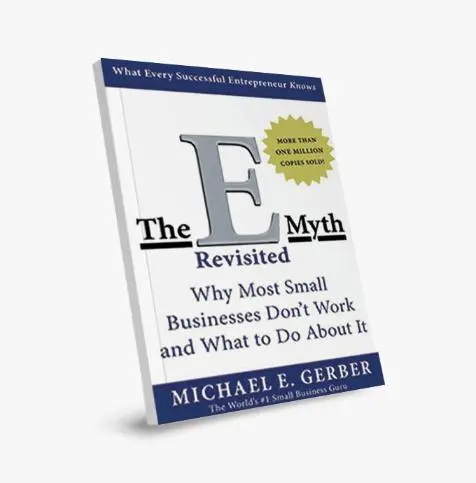
"The E-Myth Revisited: Why Most Small Businesses Don't Work and What to Do About It" by Michael E. Gerber is the most influential book on small business entrepreneurship ever written. With over 5 million copies sold and translated into 27 languages, Gerber dismantles the fatal belief that being good at a technical skill makes you good at running a business. His central message: work ON your business, not just IN your business.
"Contrary to popular belief, my experience has shown me that the people who are exceptionally good in business aren't so because of what they know, but because of their insatiable need to know more." - Michael E. Gerber
BOOK SUMMARY
The E-Myth:
The "Entrepreneurial Myth" (E-Myth) is the false idea that understanding the technical part of a business means understanding the business. Gerber explains this is catastrophic:
The excellent baker opens a bakery... and fails
The brilliant lawyer opens a firm... and fails
The talented programmer launches a startup... and fails
Why they fail:
Because being technical and being an entrepreneur are completely different skills. The technician knows how to do the work; the entrepreneur knows how to build a system that does the work.
The three internal characters:
Every entrepreneur contains three conflicting roles:
1. The Entrepreneur:
Lives in the future, sees possibilities
Is the dreamer, the visionary, the innovator
Wants to grow, change, expand constantly
Danger: Without control, generates chaos with constant direction changes
2. The Manager:
Lives in the past, seeks order
Is the organizer, the systematizer, the planner
Wants stability, predictability, control
Danger: Without vision, generates bureaucracy that suffocates innovation
3. The Technician:
Lives in the present, does the work
Is the expert, the craftsperson, the executor
Mantra: "If you want something done right, do it yourself"
Danger: Without delegation, the technician becomes a slave to their own business
The problem: Most entrepreneurs are 70% technician, 20% manager, 10% entrepreneur. They need balance.
Working IN vs. ON the business:
Working IN the business:
Doing the technical work
Serving customers
Solving day-to-day operational problems
The technician loves this
Working ON the business:
Designing systems and processes
Planning strategy
Building the machine, not operating it
The entrepreneur/manager does this
The most important phrase in the book: "If your business depends on you, you don't have a business, you have a job. And it's the worst job in the world because you're working for a lunatic: yourself."
The franchise model:
Gerber proposes designing every business as if it were a franchise -even if you never franchise:
The franchise prototype:
Systematize everything: how to open, operate, close
Document every process in operations manuals
Design so anyone can operate it following the manual
The business must work without the founder's constant presence
Benefits:
Scalability: You can open more locations
Replicability: Others can execute your model
Value: The business has sale value independent of you
Freedom: You can be absent without collapse
The stages of business:
1. Infancy:
The entrepreneur does everything
Initial euphoria of the "entrepreneurial seizure"
Quickly becomes overwhelming
Many fail here (burnout, lack of money)
2. Adolescence:
Hiring first help
Delegation crisis: "Nobody does it like me"
If the entrepreneur doesn't learn to delegate, the business stalls
Many return to infancy (fire everyone and do it all again)
This book is the cure for the most common entrepreneur disease: confusing technical skill with business capability. Many talented people fail because they think being good at something (cooking, programming, designing) makes them capable of building a business around it. Gerber explains with raw honesty why it isn't so.
I especially recommend it because it's therapeutic. Reading it hurts -it confronts you with all the excuses you tell yourself- but it's necessary. If you work 60+ hours weekly in your own business and feel you're not moving forward, this book explains why: you're a technician with a poorly paid job, not an entrepreneur with a business.
The distinction between "working in" vs. "working on" the business is transformative. The challenge for every technician entrepreneur is moving from executing tasks to building replicable systems.
The franchise model is counterintuitive but brilliant. Designing your business as if you were going to franchise forces systematization. Even if you never franchise, the result is a scalable and sellable business. Without that, you have a glorified job.
The three internal characters explain many conflicts. The entrepreneur in me wants to launch 10 new products; the manager wants to systematize existing ones; the technician wants to teach classes personally. Recognizing these roles helps manage internal conflict and build balance.
The innovation-quantification-orchestration cycle is key for any business. Innovate, measure results, and standardize what works. It's slow at first, but builds valuable assets.
This book is mandatory reading for anyone who has said "it would be great to have my own business" without understanding what that really means. After reading it, you either abandon the idea or commit to building a real business, not a job in disguise.
Reading is the beginning. Applying is the leap.
At Scalabl you don't stop at the summary: you take the best business ideas to your own venture. Our flagship Entrepreneurship & Innovation Course: 10 years running, graduates in 50+ countries, 12 modules at your own pace.