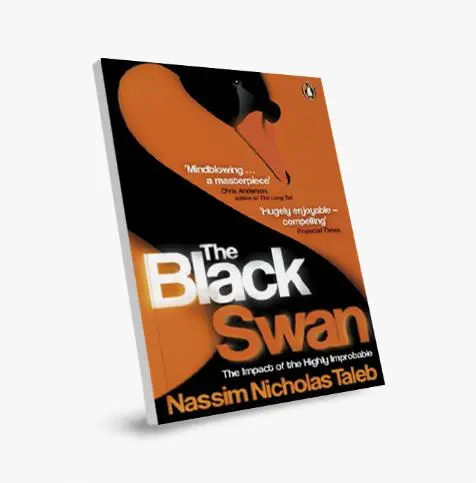
"The Black Swan: The Impact of the Highly Improbable" by Nassim Nicholas Taleb examines the extreme impact of highly improbable and highly unpredictable events (which he calls "Black Swans"). These events, like global financial crises, radical technological breakthroughs, or pandemics, change human history, but our minds and systems are configured to ignore them.
"Black Swan events have three attributes: first, they are outliers, outside the realm of regular expectations; second, they carry extreme impact; third, despite their rarity, human nature makes us invent explanations for their occurrence retrospectively, making them explainable and predictable." - Nassim Nicholas Taleb
BOOK SUMMARY
Taleb harshly criticizes excessive confidence in predictive models, economic experts, and Gaussian statistics (bell curve), which underestimate extreme randomness. The book invites us to accept the intrinsic uncertainty of the world and to build structures (personal, economic, and corporate) that don't break in the face of the unknown, but can survive these extreme events.
The book develops several fundamental concepts:
The Problem of Induction: Our tendency to extrapolate the future based on the past. Just because a black swan has never been seen doesn't mean it doesn't exist. History is dominated by unpredictable events that break established trends.
Retrospective Narrative: After an extreme event occurs, we tend to rationalize it ("we saw it coming," "the signs were there"). Taleb demonstrates this is an illusion: Black Swans are by definition unpredictable before they occur.
The Fallacy of Silent Evidence: We focus on what we see (surviving successes) ignoring what we don't see (invisible failures). This makes us overestimate our ability to predict and underestimate the role of chance.
The Asymmetry Game: Taleb explores how structures that have more losses than gains (negative asymmetry) are eventually doomed, while those with positive asymmetry (limited losses, unlimited gains) can benefit from Black Swans.
Mediocristan vs. Extremistan: Distinguishes between domains where traditional statistics work (height, weight) and domains where it doesn't work (wealth, book impact, financial events), where a single event can dominate the entire distribution.
The business world is full of gurus, analysts, and five-year business plans that pretend to control uncertainty. In "The Black Swan," Taleb demonstrates with crushing lucidity that all that illusion of control is false and extremely dangerous.
I chose this book because it's a punch in the jaw to corporate superficiality. As a strategist, if you create a rigid business model that depends on everything going exactly as you planned in an Excel spreadsheet, a single "Black Swan" will wipe you off the map. You can't predict the volatility of today's world, but you can design an optional business model capable of adapting quickly.
This book was the bridge that led me to antifragility. Taleb changes the way you think about risk: it removes the arrogance of believing you know what's going to happen and forces you to focus on resilience. Understanding that there are events you cannot predict, but can prepare to survive, is essential for anyone who wants to build businesses in the current era.
In a world where complexity increases exponentially, continuing to believe that the future can be modeled in a spreadsheet is a form of professional blindness. Taleb doesn't tell you what will happen; he teaches you not to trust those who claim to know.
Reading is the beginning. Applying is the leap.
At Scalabl you don't stop at the summary: you take the best business ideas to your own venture. Want AI in your company's operation and strategy? We identify the problem, design the strategy and build the solution — real software with AI — integrated with your team, week by week.