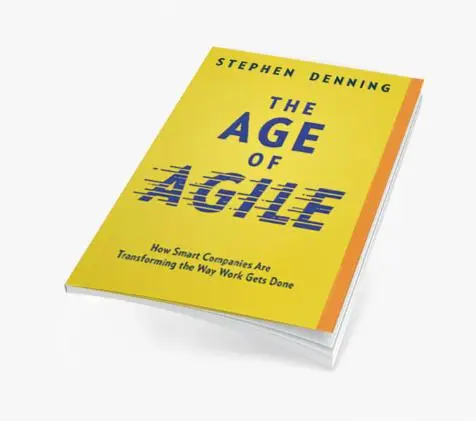
"The Age of Agile" by Stephen Denning is a manifesto on how agility has ceased to be a software methodology to become the predominant management form of the 21st century. Denning, former Director of Knowledge Management at the World Bank, documents how companies like Amazon, Spotify, Netflix and others have adopted agile principles to transform not only their development processes but their entire organizational culture and business strategy.
"The agile age isn't about processes or tools; it's about a new way of leading and organizing work based on continuously delivering value to the customer through self-organizing teams." - Stephen Denning
BOOK SUMMARY
Denning argues that traditional management -hierarchical, predictive, controlling- is obsolete in a world of complexity and accelerated change. The Age of Agile presents three fundamental laws characterizing agile organizations:
The three laws of agile management:
1. The Law of the Small Team:
Work is organized around small teams (5-9 people), self-organizing and multi-functional, with authority to make decisions without permission from upper management layers.
2. The Law of the Customer:
All decisions and priorities are oriented toward value for the end customer. The customer isn't a passive recipient of the final product but an active collaborator throughout development.
3. The Law of the Network:
Agile organizations function as networks of interconnected teams, not hierarchical pyramids. Information flows horizontally, not vertically.
Agile beyond software:
Denning demonstrates agile principles apply to any industry: manufacturing, healthcare, education, government.
The role of leadership:
Agile leaders are different: visionaries, facilitators, coaches, and data-driven decision makers.
This book is a mandatory update for anyone who thinks "agile" just means "Scrum for software developers." Denning demonstrates agility is a paradigm shift in how we organize human work.
I especially recommend it because I operate in high uncertainty environments: education, technology, emerging markets. Five-year plans are fantasies. What we need is rapid adaptation capacity.
The "law of the small team" resonates deeply. It's a well-documented pattern: when teams grow beyond 8-9 people, communication degrades. Keeping teams small and giving them real autonomy (not just rhetoric) is key to speed.
If you're managing any creative, knowledge, or innovation team, this book gives you the framework to compete in today's economy.
Reading is the beginning. Applying is the leap.
At Scalabl you don't stop at the summary: you take the best business ideas to your own venture. Our flagship Entrepreneurship & Innovation Course: 10 years running, graduates in 50+ countries, 12 modules at your own pace.