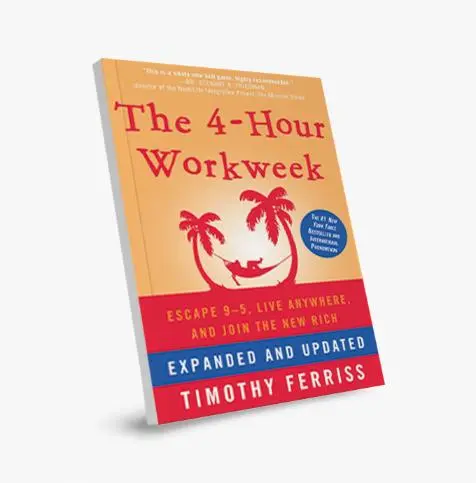
The 4-Hour Work Week by Tim Ferriss is the book that popularized an idea that sounded absurd in 2007: that it is possible to design a life where work occupies a minimal fraction of time without sacrificing income. Ferriss doesn’t propose working less out of laziness, but radically redesigning the relationship between time, money, and freedom. With a concrete method for automating income, eliminating the unnecessary, and living wherever you want, this book challenged the rules of the traditional work game and created a generation of lifestyle entrepreneurs.
“Focus on being productive instead of busy.” — Tim Ferriss
BOOK SUMMARY
Ferriss structures the book in four steps that form the acronym DEAL:
D — Definition: Redefine the rules of the game. Ferriss introduces the concept of the “New Rich” (NR): people who prioritize time and mobility over money accumulation. The question is not “how much do I earn?” but “how much do I live?”. It includes exercises to define your desired lifestyle and calculate its real cost, which is usually much lower than you imagine.
E — Elimination: Apply the Pareto Principle (80/20) and Parkinson’s Law to everything. 80% of results come from 20% of activities. Work expands to fill the time available. Ferriss proposes an information diet (stop consuming news), eliminating unnecessary meetings, and systematically learning to say no to everything that isn’t essential.
A — Automation: Create an income system that works without constant presence. Ferriss details how to create “muses” —small, automated businesses that generate passive income— using virtual assistants, strategic outsourcing, and digital products. The key is designing the business so it doesn’t depend on you from the start.
L — Liberation: Disconnect location from work. Ferriss gives concrete tactics for negotiating remote work, creating mini-retirements instead of waiting for traditional retirement, and designing a life where travel and experiences are integrated into everyday life, not postponed for “someday.”
A key aspect of the book is the distinction between absolute income and relative income. Someone earning $40,000 working 10 hours a week from Thailand has more real freedom than someone earning $200,000 working 80 hours in Manhattan. Ferriss forces you to rethink what it truly means to be “rich” and proposes that real wealth is measured in free time and experiences, not in bank balance.
I read this book on a plane years ago and I remember that by the time we landed, I had already written down 10 things I wanted to change. Years later, I ended up living as a digital nomad for a long time, traveling the world and working from wherever I wanted, following exactly the principles Ferriss lays out in this book. I can attest that they work. Ferriss has the ability to make you feel like you’re living inefficiently —not because you work too little, but because you work too much on things that don’t matter.
What impacted me most was the idea of relative income. It made me rethink decisions that seemed obvious: accepting a project that pays very well but consumes all your time versus one that pays less but leaves you weeks free. That logic changed how I evaluate opportunities to this day.
It should be read with a critical filter. Some ideas are easier to implement for someone without a family or with savings, and the tone can sometimes sound overly optimistic. But the underlying principles —automate the repetitive, eliminate what doesn’t generate value, and question the time-money equation we take for granted— are radically useful for any entrepreneur.
Additionally, Ferriss was a pioneer in something that is common today but was revolutionary in 2007: demonstrating that a small, well-designed digital business can give you more freedom than a six-figure corporate position. For those thinking about launching something of their own, this book helps design from the beginning a model that doesn’t enslave you.
Read it not as a literal manual but as a thought exercise: what would happen if you designed your business around your ideal life, instead of adapting your life to your business?
Reading is the beginning. Applying is the leap.
At Scalabl you don't stop at the summary: you take the best business ideas to your own venture. Our flagship Entrepreneurship & Innovation Course: 10 years running, graduates in 50+ countries, 12 modules at your own pace.