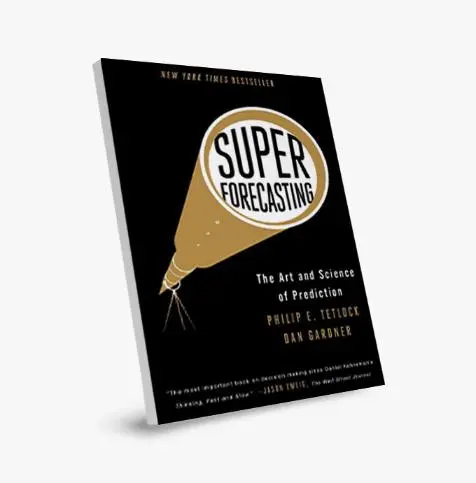
Superforecasting by Philip Tetlock and Dan Gardner is a rigorous exploration of the art and science of prediction. Based on the Good Judgment Project, a decades-long study involving thousands of forecasters, the book demonstrates that the ability to anticipate the future is not a mystical gift but a trainable skill. In a world where strategic decisions depend on projections about markets, technologies, and geopolitics, this book offers a disciplined framework for improving the quality of our judgments.
“Foresight isn’t a gift. It is a skill that can be cultivated.” — Philip Tetlock
BOOK SUMMARY
The book originates from Tetlock’s discovery that most prediction experts—political analysts, economists, military strategists—are not significantly better than chance when it comes to forecasting future events. However, the Good Judgment Project revealed that a small group of people, the “superforecasters,” consistently outperform experts and even intelligence analysts with access to classified information. Tetlock and Gardner devote the book to understanding what makes these individuals different and how anyone can develop the same skills.
Superforecasters share specific characteristics: they are open-minded thinkers who constantly update their beliefs in the face of new evidence. They think in probabilities, not certainties. They break complex problems down into manageable components. They are intellectually humble, recognize the limits of their knowledge, and actively seek information that contradicts their hypotheses. Tetlock uses Isaiah Berlin’s metaphor of foxes and hedgehogs: hedgehogs know one big thing and filter everything through that lens; foxes know many small things and are able to integrate multiple perspectives. Superforecasters are quintessential foxes.
The book also addresses the psychological obstacles that hinder good prediction: confirmation bias, overconfidence, the tendency to cling to first impressions, and resistance to changing one’s mind. Tetlock demonstrates that the greatest enemy of a good forecast is not lack of information, but mental rigidity. The best forecasters are not those who know the most, but those who best process what they know and most quickly adjust their models when reality sends new signals.
The ability to forecast is fundamental for any entrepreneur or business leader, yet it is rarely addressed as a skill that can be systematically improved. Every strategic decision—from launching a product to entering a new market, from hiring a team to pivoting a business model—is fundamentally a bet on the future. What Tetlock teaches us is that the quality of those bets can be dramatically improved with the right discipline. It is not about guessing, but about calibration: knowing how much confidence to place in each forecast and constantly adjusting in the face of new information.
At Scalabl®, we work with entrepreneurs who face radical uncertainty on a daily basis. The difference between those who navigate that uncertainty well and those who do not usually lies precisely in the mental habits Tetlock describes: the ability to hold multiple hypotheses simultaneously, the discipline of updating beliefs with real data instead of clinging to the original plan, and the intellectual humility to recognize when one was wrong. The best entrepreneurs I have known operate exactly like superforecasters: they do not fall in love with their predictions; they fall in love with the truth.
I recommend this book to anyone who makes decisions under uncertainty, which is practically everyone. The most powerful lesson is that forecasting is not an innate talent but a set of practices that can be learned. The book does not promise certainty—that would contradict its own thesis—but it does offer a clear path to being wrong less often and learning faster from mistakes. In a world where most expert predictions turn out to be barely better than a coin flip, that edge can be decisive.
Reading is the beginning. Applying is the leap.
At Scalabl you don't stop at the summary: you take the best business ideas to your own venture. Our flagship Entrepreneurship & Innovation Course: 10 years running, graduates in 50+ countries, 12 modules at your own pace.