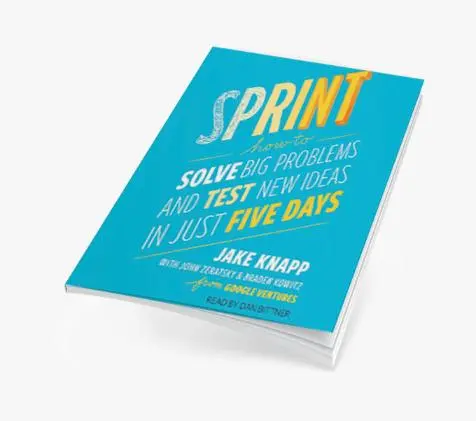
Sprint: How to Solve Big Problems and Test New Ideas in Just Five Days by Jake Knapp, John Zeratsky, and Braden Kowitz is a practical and detailed guide to the design sprint process developed at Google Ventures. The book presents a structured five-day method for answering critical business questions through design, prototyping, and testing with real users. In an entrepreneurial ecosystem where time and resources are scarce, this method offers a radical alternative to the endless cycles of debate, analysis, and planning that paralyze so many teams.
“The idea is not to solve everything forever. The idea is to find the right direction and take a huge leap in just five days.” — Jake Knapp
BOOK SUMMARY
The Sprint method is structured around five days, each with a clear and inviolable objective. Monday is dedicated to mapping the problem: the team identifies the main challenge, interviews internal experts, and selects a specific target for the week. Tuesday is solutions day: each participant generates ideas individually (not in a group, avoiding groupthink) and presents them in a structured format. Wednesday is decision day: the team votes, the “Decider” (usually the CEO or product lead) has the final say, and a detailed storyboard of the winning solution is created. Thursday is for building a realistic prototype —not a finished product, but a convincing facade that allows testing the hypothesis with real users—. Friday involves five interviews with target users, observing their reactions and gathering direct feedback.
What distinguishes the Sprint method from other innovation methodologies is its deliberate time rigidity. Knapp argues that time constraint is not a compromise but an advantage: it forces the team to make rapid decisions, eliminates endless discussions, and creates a sense of urgency that unlocks creativity. The book includes dozens of real cases from Google Ventures —from startups to companies like Slack, Blue Bottle Coffee, and the Gates Foundation— where sprints produced insights that would have taken months or years through conventional processes. It also details the necessary roles (Facilitator, Decider, experts), room rules (no devices, no multitasking), and required physical materials (whiteboards, sticky notes, timers), making the method replicable by any team willing to try it.
Sprint is one of the most practical innovation tools available. The beauty of the method lies in its constraint: five days, no more, no less. At Scalabl®, we use sprint-like dynamics in our acceleration programs because time pressure forces clarity and action. I have seen teams spend months debating a new feature, writing specification documents, and conducting market research, only to discover at launch that nobody needed it. The sprint compresses that entire process into one week and, most importantly, puts the idea in front of real users before investing a single dollar in development.
This book is a masterclass in structured experimentation. The concept of a prototype as a “facade” is particularly powerful: you don’t need to build a real product to validate a hypothesis. A prototype can be an interactive presentation, a static website, or even a simulation with basic tools. What matters is that the user believes it is real and reacts authentically. This philosophy connects directly to Lean Startup thinking but operationalizes it in a much more concrete and actionable way. I recommend this book to any team that needs to stop planning and start validating. It is especially useful for founders facing critical product decisions who cannot afford to be wrong for months.
Reading is the beginning. Applying is the leap.
At Scalabl you don't stop at the summary: you take the best business ideas to your own venture. Our flagship Entrepreneurship & Innovation Course: 10 years running, graduates in 50+ countries, 12 modules at your own pace.