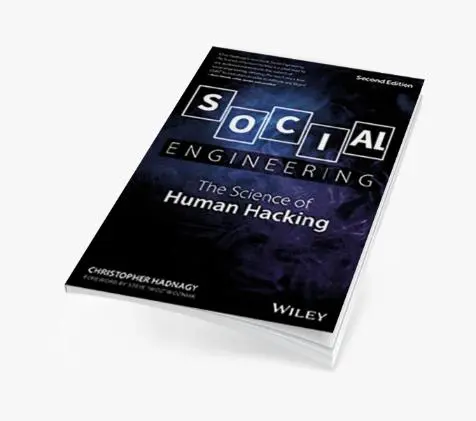
Social Engineering: The Science of Human Hacking by Christopher Hadnagy is a deep and revealing exploration of how human vulnerabilities are exploited to compromise the security of individuals and organizations. The book examines the techniques that social engineers use to manipulate human behavior —from pretexting and phishing to elicitation and body language reading— and provides a systematic framework for understanding and defending against these attacks. In an increasingly digitized world where technology advances faster than awareness of its risks, this book becomes essential reading for business leaders, entrepreneurs, and anyone responsible for protecting sensitive information.
“Humans are the weakest link in any security chain. No matter how much technology is implemented, if people can be manipulated, the entire system is vulnerable.” — Christopher Hadnagy
BOOK SUMMARY
Hadnagy organizes the book around the main vectors of social engineering, beginning with the OSINT (Open Source Intelligence) model: how attackers gather public information about their targets through social media, public records, and digital metadata to build detailed profiles before making any direct contact. He then delves into pretexting —the art of creating a believable fictitious scenario to obtain information or access— showing how attackers impersonate support technicians, auditors, vendors, or even colleagues to gain their victims’ trust. The book details how each pretext requires prior research, narrative coherence, and a deep understanding of the target’s psychology.
The book also examines elicitation techniques —how to extract sensitive information through seemingly innocent conversations— and dedicates full chapters to phishing, vishing (phone phishing), and body language manipulation. Hadnagy explains how Cialdini’s principles of influence —reciprocity, commitment, social proof, authority, liking, and scarcity— are systematically used by social engineers to overcome people’s natural defenses. What makes this book particularly valuable is that it does not merely describe attacks: it offers a complete defensive framework, including the creation of human security policies, awareness programs, and verification protocols that significantly reduce any organization’s social attack surface.
Understanding social engineering is essential for any business leader —not to manipulate, but to protect. Every company, regardless of its size or industry, is vulnerable through its people. I have seen organizations invest millions in firewalls, encryption, and cutting-edge security systems, only to fall to a simple phishing email because nobody trained the team to recognize it. At Scalabl®, when we work with entrepreneurs in growth stages, we always emphasize that information security is not just a technical issue: it is an organizational culture issue. This book demonstrates that with a forcefulness that is hard to ignore.
What makes this book special is its direct connection to Cialdini’s persuasion principles, but from the security angle. While Influence and Pre-Suasion show how to use these principles ethically in marketing and negotiation, Hadnagy reveals how the same psychological mechanisms are exploited by attackers. Reciprocity, authority, urgency: all these levers that we legitimately use in business are the same ones a social engineer employs to access systems, data, and resources. Understanding both sides of the coin is not optional in today’s world: it is a leadership responsibility. I recommend this book to anyone who manages teams, sensitive data, or strategic business relationships.
Reading is the beginning. Applying is the leap.
At Scalabl you don't stop at the summary: you take the best business ideas to your own venture. Our flagship Entrepreneurship & Innovation Course: 10 years running, graduates in 50+ countries, 12 modules at your own pace.