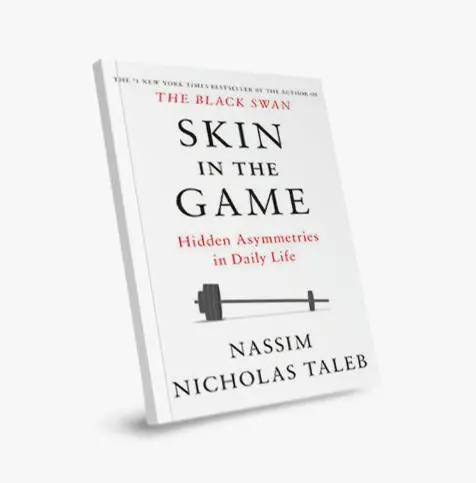
"Skin in the Game: Hidden Asymmetries in Daily Life" by Nassim Nicholas Taleb is the fifth book in his Incerto series, and possibly the most provocative. Taleb, a former options trader turned philosopher of uncertainty, argues that most problems in the world -from financial crises to expert incompetence- arise from a lack of "skin in the game." When people can benefit from their decisions without suffering the consequences of their mistakes, the system becomes corrupted.
"Skin in the game is not just necessary for justice, commercial efficiency, and risk management: skin in the game is necessary for understanding the world." - Nassim Taleb
BOOK SUMMARY
The book explores four intertwined themes: uncertainty and reliability of knowledge, symmetry in human affairs (justice, responsibility), information exchange in transactions, and rationality in complex systems.
What is Skin in the Game?
It's the amount of risk or personal interest you have in an outcome. The more you have to lose, the more "skin" you have in the game. Taleb's golden rule: "If you don't have skin in the game, don't get involved."
The silver rule and asymmetry:
Taleb expands the golden rule (treat others as you want to be treated) to the silver rule: don't do to others what you don't want done to you. Asymmetries occur when one party in a transaction has more information or assumes less risk than the other.
The agency problem:
Occurs when someone (the agent) makes decisions that affect another (the principal), without acting in the principal's best interest. Examples everywhere:
Investment bankers: Take bonuses when they win, taxpayers pay when they lose
Consultants: Charge you for recommendations, assume no risk if their advice fails
Politicians: Make decisions affecting millions, live protected from consequences
Journalists: Generate clicks with sensational headlines, don't suffer for false information
The Intellectual Yet Idiot (IYI):
One of the book's most viral concepts. Taleb describes the "Intellectual Yet Idiot": people with impressive academic credentials but no practical experience in the real world. IYIs:
Write papers nobody reads about problems they don't understand
Propose policies they would never have to live with themselves
Despise the "uneducated" who actually have skin in the game (plumbers, taxi drivers, merchants)
Use complex vocabulary to hide simple thinking
The intolerant minority wins:
Taleb mathematically demonstrates that in many systems, an inflexible minority can impose their preferences on the majority. Examples:
Kosher products are mainstream because an inflexible minority demands them
Specific dietary norms can expand when certain groups are inflexible
The intolerant impose virtue on the tolerant
The Lindy effect:
If something has survived a long time, it will probably continue surviving. Books that have been in print for 100 years will remain relevant. Diet fads will disappear. This is a filter to identify who really has skin in the game: survivors of time.
The rich are easier to scam:
Paradoxically, people with lots of money have less skin in the game in individual transactions. For a seller, scamming a rich person is more profitable than honestly selling to someone middle-class. The rich are more disconnected from the consequences of each purchasing decision.
The ethics of creation:
Taleb makes a passionate defense of artisans, merchants, and small business owners versus employees of large corporations. The former have real skin in the game: if they fail, they lose everything. The latter can fail, be fired, and find another similar job.
Practical implications:
Never trust financial advice that doesn't put its own money where its mouth is
Distrust experts who can't explain their point in simple words
Prefer doctors who have treated thousands of cases over researchers who have published papers
Regulations written by bureaucrats without practical experience generally worsen problems
This book is a punch in the mouth of the academic and corporate establishment. Taleb is arrogant, provocative, and often exasperating -but he's fundamentally right. The world is full of "experts" who give advice without assuming risk, and systems that reward appearance over substance.
I especially recommend it because it's therapeutic. If you've ever felt frustrated by a consultant who charged a fortune for obvious recommendations, or by a politician who has never run a business dictating corporate policies, this book validates your irritation. You're not crazy; the system is designed to protect those without skin in the game.
The concept of the "Intellectual Yet Idiot" is dangerously useful. At Scalabl we're conscious of falling into this trap: we write about entrepreneurship, but do we have enough skin in the game? That's why we face our own businesses, not just teach theory. If we're not risking something real, our advice is noise.
The rule of "never trust advice without skin in the game" we apply in investments. We don't follow recommendations from analysts who don't invest their own money. We don't hire consultants who haven't built businesses. Credibility comes from exposure to risk, not from credentials.
The chapter on "the intolerant minority wins" has massive strategic implications. If your product serves a passionate, inflexible minority, you'll eventually dominate the mainstream market. It's the strategy of going for fanatical early adopters instead of trying to please everyone.
Taleb isn't easy to read. He jumps between topics, uses seemingly irrelevant stories, and attacks his personal enemies. But if you persist, you'll find a philosophy of life: true wisdom comes from exposure to risk, not from reading books in cushioned libraries.
If you're an entrepreneur, this book will remind you that your advantage is precisely that you have everything to lose. Corporate employees can make mistakes; you can't. That pressure is your superpower.
Reading is the beginning. Applying is the leap.
At Scalabl you don't stop at the summary: you take the best business ideas to your own venture. Our flagship Entrepreneurship & Innovation Course: 10 years running, graduates in 50+ countries, 12 modules at your own pace.
by Nassim Nicholas Taleb The first Incerto book, about how we confuse luck with skill, especially in financial markets. The introduction to Taleb's thinking on uncertainty.
Let's talk
Leave your details and the team will contact you.
📚
LucíaBusiness Library · Scalabl®
What is your name? What are you looking to learn these days?