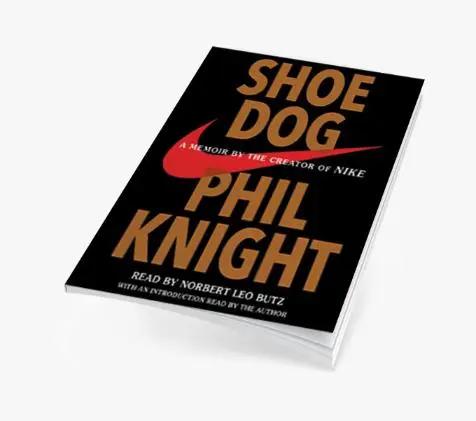
Shoe Dog by Phil Knight is the autobiography of Nike’s founder, one of the most honest and moving entrepreneurship stories ever written. Knight tells how he went from selling Japanese running shoes out of his car trunk to building a $30 billion global brand, without hiding the years of crushing debt, partner conflicts, lawsuits, and moments where everything was about to collapse. It is not a business manual: it is a love letter to the entrepreneurial journey with all its scars.
“The cowards never started and the weak died along the way. That leaves us.” — Phil Knight
BOOK SUMMARY
Knight structures Shoe Dog as a chronological chronicle from 1962 to Nike’s IPO in 1980, with reflections on the years that followed. The central themes include:
The “Crazy Idea”: It all began with a college paper about importing running shoes from Japan. Knight traveled to Kobe, convinced the Onitsuka Tiger factory that he represented a company that didn’t yet exist, and imported his first boxes. What drove him wasn’t money but a visceral conviction that running could change lives.
Years of financial survival: For over a decade, Nike (initially Blue Ribbon Sports) operated on the brink of bankruptcy. Knight borrowed to pay off loans, negotiated deadlines with banks that wanted to close his account, and reinvested every cent in inventory. The book shows that lack of capital is not an obstacle but a constant of entrepreneurship.
The founding team: Knight describes with affection and humor the “Buttfaces” —his nickname for the original team’s meetings—: Jeff Johnson (the obsessive first employee), Bob Woodell (who kept working from a wheelchair), Bill Bowerman (the co-founding coach who invented soles with a waffle iron). He shows that great teams are built with passionate people, not perfect resumes.
Conflicts and betrayals: The relationship with Onitsuka Tiger broke down in a fierce legal battle. Knight faced industrial espionage, supplier threats, and the constant tension between depending on a Japanese partner and creating his own brand. That breakup forced the creation of Nike as an independent brand.
Building a brand culture: Knight understood before anyone else that he wasn’t selling shoes but an identity. The name Nike (Greek goddess of victory), the Swoosh designed by a student for $35, and the first athlete sponsorships created a brand that transcended the product.
The book closes with honest reflections on the personal costs of the journey: the strained relationship with his sons, the loss of his eldest son, and the constant question of whether it was all worth it. Knight doesn’t give an easy answer, and that is what makes the book so powerful.
Shoe Dog is the book I recommend to anyone who idealizes entrepreneurship. Knight hides nothing: the debts, the fear, the broken relationships, the years of total uncertainty. And at the same time he conveys something no other business book achieves: the beauty of the journey itself, regardless of the outcome.
What impacted me most was how for 15 years Nike was always one week away from shutting down. The myth that great companies were born with a perfect plan is exactly that: a myth. Nike was built by improvising, fighting with banks, and making decisions with incomplete information. That resonates deeply with the reality of any entrepreneur.
I was also moved by how Knight talks about his team. He doesn’t look for people with perfect credentials but for people who love what they do with unreasonable intensity. Jeff Johnson wrote him letters every day without getting a reply and kept going. Bowerman experimented with soles in his kitchen. That irrational passion is the ingredient no MBA teaches.
There is a moment in the book that stayed with me: when Knight describes that even after the IPO, with millions in the bank, he still felt the same anxiety as when he had nothing. That seems to me the most honest truth about entrepreneurship: the journey never gets comfortable, and maybe it shouldn’t.
Read it when you need to remember why you started. It’s not a book of formulas, it’s a book of soul.
Reading is the beginning. Applying is the leap.
At Scalabl you don't stop at the summary: you take the best business ideas to your own venture. Want AI in your company's operation and strategy? We identify the problem, design the strategy and build the solution — real software with AI — integrated with your team, week by week.