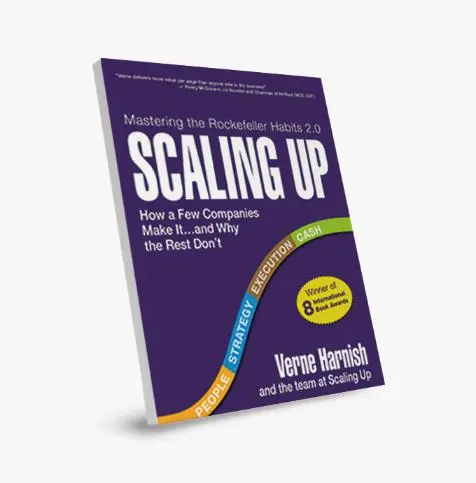
"Scaling Up: How a Few Companies Make It... and Why the Rest Don't" is the update of Verne Harnish's "Rockefeller Habits" methodology. The book addresses the "Valley of Death" for businesses: that phase where a company has surpassed its initial startup stage but suffers unbearable growing pains that threaten to destroy it from within.
"Growth is easy. The hard part is growing without losing control, culture, and profitability." - Verne Harnish
BOOK SUMMARY
Harnish provides a set of practical tools and frameworks organized around four fundamental pillars. The goal is to help leaders scale complexity without losing control or profitability.
The Four Pillars of Scaling Up:
1. People (Team): Harnish emphasizes that sustainable growth depends on having the right people in the right roles. Tools include:
FACe (Function Accountability Chart): Defines key company functions, their KPIs, and evaluates if we have the right people.
PACe (Process Accountability Chart): Maps the company's main processes to systematically improve them.
Values and Purpose: Used not as words on a wall, but as real criteria for hiring, firing, and recognition.
2. Strategy: Scaling isn't just selling more, but creating a unique proposition. The book teaches:
Define the Brand Promise: What you promise your customers and how you differentiate.
Identify Differentiating Activities: What you do uniquely to fulfill that promise.
Use the One-Page Strategic Plan (OPSP): A concise document that aligns the entire organization.
3. Execution: Converting vision into frictionless routines through:
There's an abyssal difference between starting a business and making it grow. In the initial stage, speed and experimentation are everything. But when you reach 15, 30, or 50 employees, the founder's intuition is no longer enough. What brought you here won't take you to the next level.
I recommend Harnish because "Scaling Up" is purely tactical and architectural. Many SMEs stagnate because they try to grow by adding more chaos to chaos. Scaling requires structure and method. This book gives you operational tools (like synchronized daily meetings or cash flow cycles) to align your entire company behind the same objectives.
If you feel your organization is growing but your profit margin is shrinking, or that your teams are disconnected from central strategy, this manual will give you the operational order you need to accelerate without crashing the ship. Harnish doesn't promise magical growth; he gives you the instruction manual to build an organization that can grow sustainably.
Reading is the beginning. Applying is the leap.
At Scalabl you don't stop at the summary: you take the best business ideas to your own venture. Our flagship Entrepreneurship & Innovation Course: 10 years running, graduates in 50+ countries, 12 modules at your own pace.