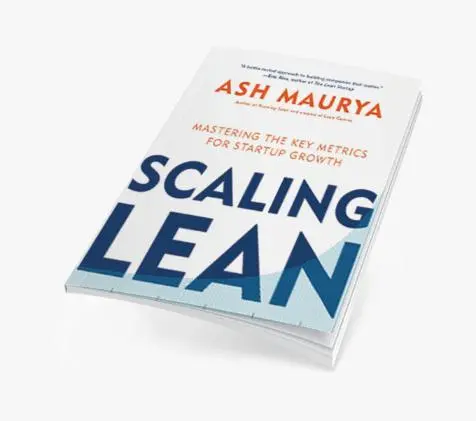
"Scaling Lean" by Ash Maurya is the practical handbook for taking a startup from product-market fit to sustainable scale. While "Running Lean" focuses on finding the business model, this book teaches how to measure and optimize real growth using actionable metrics instead of vanity metrics.
"Traction is the goal. It's not about growing fast, but growing smart." - Ash Maurya
BOOK SUMMARY
Ash Maurya challenges the obsession with growth at all costs and proposes a system based on customer throughput: the speed at which users convert into paying, loyal customers.
Key Concepts:
Traction as the Goal: Traction is defined as the rate at which a business model captures monetizable value from its users. It's not just growth or vanity metrics like visits or downloads: it's measurable progress toward a sustainable business.
Customer Throughput: A measure of how efficiently your "customer factory" converts leads into paying customers. Tracks the flow of users through five stages: acquisition, activation, retention, revenue, and referral.
The Customer Factory Blueprint: A visual framework that models your business as a production line for creating happy customers. Allows you to identify where your growth is stuck and which improvements will have the biggest impact.
Fermi Estimates: A method for making quick, approximate calculations that determine whether a business idea has enough potential before investing time in building it.
Minimum Success Criteria: The smallest measurable outcome that would make your business idea worth pursuing. Forces you to define what success looks like (e.g., $1M in revenue in 3 years) and reverse-engineer how many customers you need.
Cohorts vs. Aggregate Metrics: Vanity metrics show total numbers that always go up. Actionable metrics compare groups of users (cohorts) to see if new features actually improve behavior.
The problem with early-stage startup financial projections is that they're pure fiction. Filling Excel with ascending numbers is easy, but measuring real progress against uncertainty requires a different mental model.
"Scaling Lean" by Ash Maurya systematizes the measurement of iterative success. It teaches you to calculate customer lifetime value (LTV), audit the true health of your growth engine, and demonstrate traction with empirical data.
Customer throughput is the central metric: how fast do you convert users into paying customers? It doesn't matter how many users you have if they don't generate monetizable value. A startup with 1,000 active paying users is healthier than one with 100,000 downloads and zero revenue.
Maurya proposes a powerful metaphor: your business is a factory. Raw materials (users) enter on one side and finished products (happy customers) exit on the other. Your job is to maximize throughput: increase conversion speed while minimizing waste.
I recommend it because it converts "lean" theory into raw numbers. It takes away your excuses and forces you to focus on the only thing that matters: whether you're creating customers in a repeatable and sustainable way.
Reading is the beginning. Applying is the leap.
At Scalabl you don't stop at the summary: you take the best business ideas to your own venture. Our flagship Entrepreneurship & Innovation Course: 10 years running, graduates in 50+ countries, 12 modules at your own pace.