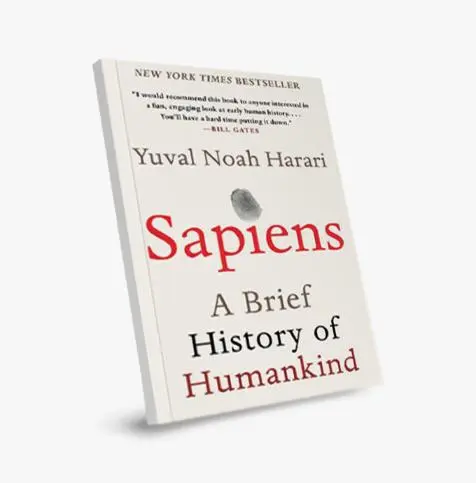
Sapiens by Yuval Noah Harari is a monumental work that spans 70,000 years of human history to explain how an insignificant species of primates ended up dominating the planet. From the Cognitive Revolution to the age of artificial intelligence, Harari shows that what made us unique was not our physical strength but our ability to create and believe in shared fictions: religions, nations, money, human rights. This book transforms the way we understand leadership, innovation, and the social structures we take for granted.
“Empires hold together not through military force but because people believe in them.” — Yuval Noah Harari
BOOK SUMMARY
Harari structures Sapiens around four great revolutions that transformed our species:
The Cognitive Revolution (70,000 years ago): Homo sapiens developed the ability to create shared fictions —myths, gods, stories— that enabled large-scale cooperation among strangers. This set us apart from every other species and laid the foundations for civilizations.
The Agricultural Revolution (12,000 years ago): Harari calls it “history’s biggest fraud.” Instead of freeing us, agriculture tied us to the land, increased working hours, and reduced the quality of our diet. But it allowed population growth and the emergence of complex social structures.
The Unification of Humankind: Money, empires, and universal religions were the three forces that connected isolated communities into a global network. Harari shows how these three shared fictions created the interconnected world we inhabit today.
The Scientific Revolution (500 years ago): The willingness to admit ignorance was the engine of scientific progress. The alliance between science, empire, and capital transformed humanity’s ability to reshape the world at an unprecedented pace.
The power of shared fictions: The central concept of Sapiens: companies, nations, religions, and money itself are collective fictions that exist because we all choose to believe in them. This has direct implications for anyone building organizations.
Sapiens is not a business book, but it is one of the books that most changed the way I think about business. When you understand that a company is a shared fiction —exactly like a religion or a nation— your approach to building culture, communicating vision, and leading teams changes forever.
What impacted me most was the idea that progress is neither linear nor inevitable. The Agricultural Revolution made us more productive but less free. The Scientific Revolution gave us power but not necessarily wisdom. That tension between advancement and unforeseen consequences is something every entrepreneur should keep in mind when building products that affect millions of people.
For those leading companies or ventures, Sapiens offers a perspective that no MBA provides: the ability to see human structures for what they truly are —collective constructions that can be redesigned—. That is both liberating and an enormous responsibility.
Read it not to learn management techniques, but to radically expand the framework from which you make decisions.
Reading is the beginning. Applying is the leap.
At Scalabl you don't stop at the summary: you take the best business ideas to your own venture. Want AI in your company's operation and strategy? We identify the problem, design the strategy and build the solution — real software with AI — integrated with your team, week by week.