
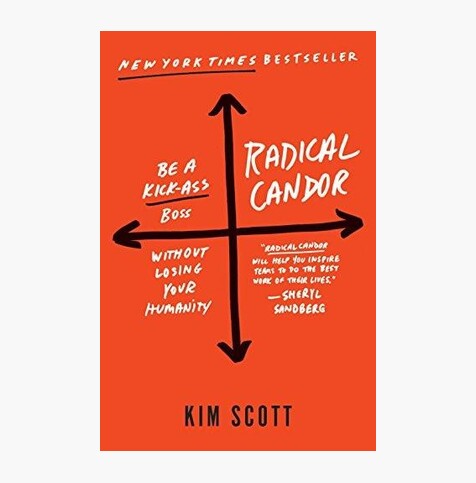
from Kim Scott
"Radical Candor" by Kim Scott has become an essential reference for leaders seeking to balance demandingness with empathy in the workplace. This book, written by an executive who worked at Google and Apple under the tutelage of Sheryl Sandberg and Steve Jobs respectively, presents a practical framework for giving honest and direct feedback without falling into aggression or evasion. Scott's methodology has been adopted by thousands of companies worldwide to transform their communication cultures and build more authentic and productive working relationships. If you're a leader, manager, or aspire to be one, this book offers concrete tools for having difficult conversations, developing your team's talent, and creating an environment where constructive criticism is seen as an act of care, not as a personal attack.
BOOK SUMMARY
Kim Scott develops a two-axis framework that defines four quadrants of workplace communication:
The Radical Candor Framework
Horizontal Axis: Personal Care
Vertical Axis: Direct Challenge
The four resulting quadrants:
1. Radical Candor - The ideal goal: you personally care about the person AND challenge them directly. That is, you say what you think with honesty because you care about their growth.
2. Obnoxious Aggression - You challenge directly but without showing you care about the person. It's "brutal honesty" without empathy.
3. Ruinous Empathy - You care about the person but avoid direct challenge. That is, you don't say what needs to be said to avoid hurting feelings, which ends up harming the person.
4. Manipulative Insincerity - You neither care about the person nor challenge them. It's hypocrisy and hallway gossip.
Key Concepts:
WHY I RECOMMEND READING THIS BOOK? By Francisco Santolo
"Radical Candor" is one of those books that changes the way you interact with your team. As an entrepreneur who has built multiple companies, I've experienced firsthand the dilemma Scott describes: how to demand excellence without becoming a tyrant? How to be empathetic without becoming a "nice" boss who doesn't help people grow?
The four-quadrant framework is brilliantly simple and effective. It has helped me identify my own tendencies: I tend to fall into "Ruinous Empathy" when I avoid difficult conversations with collaborators I appreciate. Recognizing this pattern has allowed me to work consciously toward "Radical Candor."
What I value most about this book is its immediate applicability. Scott doesn't stay in theory; she offers scripts, exact phrases, and tactics for different situations: from daily feedback to the most difficult performance conversations.
At Scalabl, we've adopted many principles from this book. The culture of "asking for feedback before giving it" has transformed our team dynamics. When leaders model vulnerability by asking for constructive criticism, they give permission for everyone else to do the same.
RELATED BOOKS
1. "Powerful" by Patty McCord - Complements "Radical Candor" with a broader perspective on organizational culture and HR practices in high-growth companies.
2. "Crucial Conversations" by Kerry Patterson et al. - Advanced techniques for handling high-stakes conversations where emotions are charged and opinions differ.
3. "The Feedback Fallacy" by Marcus Buckingham and Ashley Goodall - A Harvard Business Review article (and concepts expanded in other books) that questions some traditional feedback practices and offers strength-based alternatives.