
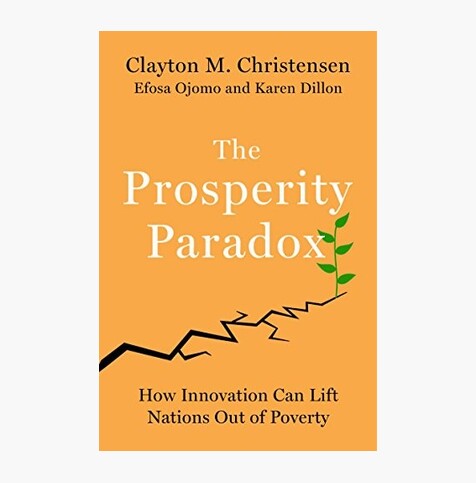
from Clayton M. Christensen, Efosa Ojomo, Karen Dillon
"The Prosperity Paradox" represents one of the most important contributions to development economics thinking in the 21st century, written by the legendary Clayton Christensen—author of "The Innovator's Dilemma"—along with Efosa Ojomo and Karen Dillon. This book challenges decades of conventional development policy by arguing that the key to eradicating poverty doesn't lie in foreign direct investment, massive humanitarian aid, or imitation of Western models, but in the transformative power of market-creating innovation. Christensen and his co-authors introduce the concept of "pull innovation"—that which creates markets where none previously existed—as the true engine of sustainable economic development. Through detailed case studies from Mexico to Nigeria, South Korea to Japan, the book demonstrates how companies that solve everyday problems for the masses generate widespread prosperity, dignified employment, and social transformation. This work is essential reading for business leaders, policymakers, impact investors, and social entrepreneurs seeking to understand how to create genuine economic value in challenging contexts. The book offers a robust conceptual framework for understanding why some countries prosper while others remain stagnant, and provides a practical roadmap for building prosperity from the base up, not from the top down.
BOOK SUMMARY
The Three Typologies of Innovation
Christensen classifies innovation into three categories that have very different impacts on economic development:
1. Efficiency Innovation: Reduces costs and optimizes existing processes. Necessary, but tends to eliminate jobs in the short term.
2. Sustaining Innovation: Improves existing products for customers who already have access to them. Benefits mainly those who already have resources.
3. Market-Creating Innovation: Transforms complicated and expensive products into affordable and accessible products for the masses. This type of innovation is the true engine of economic development because it creates jobs, infrastructure, and widespread prosperity.
The Development Paradox
The book's central premise is paradoxical: countries don't develop because they are rich, but become rich because they develop the right capabilities. Prosperity isn't the prerequisite for development, but its result. Trying to copy the institutions of rich countries without the economic fabric that sustains them is putting the cart before the horse.
Pull Innovation (Market-Creating Innovation)
This revolutionary concept describes innovations that "pull" the necessary infrastructure: when a company creates a new and viable market, it automatically generates demand for roads, electricity, education, financial systems, and regulation. It's not necessary to build infrastructure first; attractive innovation generates it naturally.
The Prosperity Ecosystem
Market-creating innovations don't just create successful companies: they generate complete ecosystems of prosperity. Local suppliers, distributors, trained workers, financial institutions, and regulatory frameworks emerge organically around viable economic opportunities.
Key Case Studies
The book examines success stories such as:
WHY I RECOMMEND READING THIS BOOK? By Francisco Santolo
As an Argentine who has built companies in emerging markets and has seen firsthand the challenges of economic development, this book spoke to me deeply. Christensen and his co-authors manage to articulate something I've felt intuitively but couldn't explain clearly: the difference between helping the poor and creating the conditions for them to generate their own prosperity.
What I value most about "The Prosperity Paradox" is its pragmatic and empowering approach. It rejects the condescending view that poor countries need to be "saved" by international aid or imitation of foreign models. Instead, it proposes that true development comes from identifying local problems—problems that affect millions of people—and creating scalable market solutions to solve them.
This book transformed my thinking about the social impact of entrepreneurship. It's not just about making money while doing good; it's about doing good sustainably requiring viable business models. Market-creating innovations are the bridge between purpose and profitability, between social impact and business success.
For any Latin American, African, or Asian entrepreneur building something meaningful, this book offers intellectual validation and a strategic framework. It reminds us that the problems we solve aren't "deficiencies" of our countries, but massive market opportunities waiting to be seized. Development doesn't come from top-down: it comes from entrepreneurs who see what others ignore.
RELATED BOOKS
1. "The Innovator's Dilemma" - Clayton M. Christensen
Christensen's seminal book on disruptive innovation. Essential for understanding why large companies fail and how new ones can triumph by challenging the status quo.
2. "Poor Economics" - Abhijit V. Banerjee and Esther Duflo
Offers an evidence-based view of how the poor live and what policies actually work to improve their lives. Perfectly complements Christensen's perspective with academic rigor.
3. "Why Nations Fail" - Daron Acemoglu and James A. Robinson
Explores the deep institutional reasons why some nations prosper while others fail. Provides historical and institutional context that enriches understanding of economic development.