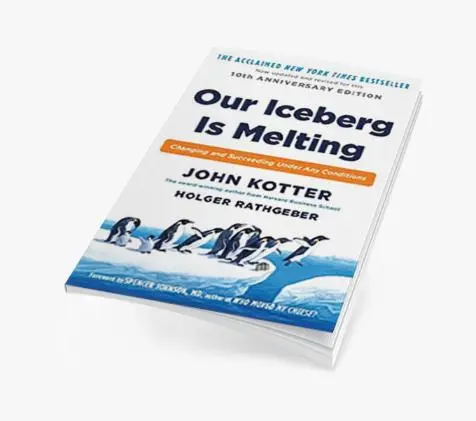
Our Iceberg Is Melting tells the story of a colony of emperor penguins living peacefully on an iceberg until one of them spots an unexpected threat: the ice is cracking and melting from within. At first many play the problem down, but the evidence becomes impossible to ignore. From there the colony is forced to react, and along that journey John Kotter introduces his well-known eight-step model for leading change, showing how each stage emerges naturally in this simple but powerful fable.
The first step — creating a sense of urgency — becomes clear as the penguins realize that ignoring the problem could be fatal. They go on to form a guiding team, diverse in skills and perspectives, to lead the adaptation process. As they progress, the group defines a clear vision, experiments with new ideas, faces internal resistance, and celebrates small wins that build momentum for change.
The fable highlights familiar obstacles that any organization faces: denial, fear, cognitive bias, political tension, and the struggle to let go of what's comfortable. At the same time, it shows how transparency, effective communication and collective participation can turn a potential crisis into an opportunity for transformation.
The story ends with the successful relocation of the colony to a new iceberg — a destination that once seemed unthinkable without the willingness to question the status quo and the courage to adapt. Beyond the metaphor, the central message is clear: adaptation isn’t a one-time project — it’s a permanent skill that enables growth, survival and evolution in changing environments.
I recommend Our Iceberg Is Melting because it’s one of the clearest and most effective books for understanding the human dynamics behind organizational change. Its simplicity doesn’t take away from its depth — on the contrary, it helps internalize concepts that often get lost in overly technical language. John Kotter translates decades of research in leadership and transformation into a story that anyone can grasp, yet one that challenges even the most experienced leaders.
In my work supporting entrepreneurs, companies and teams around the world, I’ve seen that the biggest barriers to change rarely come from a lack of information or technical ability. They come from human emotions: fear, denial, resistance, attachment, insecurity, pride. This book brings those forces to the surface with disarming honesty, allowing us to see ourselves in the characters — the skeptic, the visionary, the resistor, the facilitator, the leader who listens and enables others.
What I find especially valuable is how the story illustrates the importance of creating genuine urgency without triggering panic — a crucial distinction for leading healthy change. It also emphasizes the role of the guiding team, a concept that aligns deeply with our philosophy at Scalabl®: real change doesn’t come from individual heroes, but from diverse teams that work with clarity, purpose and shared responsibility.
The book’s core message is profoundly relevant: change isn’t a one-time event — it’s a constant state. The organizations that thrive are the ones that build adaptive capacity, curiosity, humility, and the willingness to question even the things that once made them successful. That’s why this book, though simple in form, can be truly transformative.
Reading is the beginning. Applying is the leap.
At Scalabl you don't stop at the summary: you take the best business ideas to your own venture. Our flagship Entrepreneurship & Innovation Course: 10 years running, graduates in 50+ countries, 12 modules at your own pace.
Switch: How to Change Things When Change IChip Heath & Dan Heath
Switch: How to Change Things When Change Is Hard
Chip Heath & Dan Heath
Chip Heath & Dan Heath Dives into the psychology of change, exploring how to motivate people, design environments that encourage new behaviors, and reduce emotional resistance. A great complement to Kotter’s fable with practical, research-backed tools.
Spencer Johnson Another classic fable about change, focused on how to adapt to new circumstances without clinging to old expectations. A simple yet powerful reminder of the importance of flexibility and detachment when facing uncertainty.